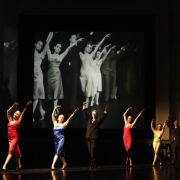
‘Age cannot wither…’ but sadly it can take away, and both those sentiments were the poignant reality of this reimagining of Pina Bausch’s legendary Kontakthof by original cast member, Meryl Tankard. When it was first created in 1978, Bausch is said to have wondered aloud what it would be like to revisit the work on the same cast in 30 years’ time.

Bausch died suddenly in 2009, and it was not until 2024 that her idea came to fruition thanks to the determination of her son, Salomon, and Tankard’s painstaking editing of 20 tapes of archival footage of the original cast taken by Rolf Borzik, Bausch’s partner and the Kontakthof designer. Using the film as both reference and counterpoint, Tankard also set about adapting the choreography to suit the remaining original dancers, now aged between 70 and 80.
After ‘phone calls around the world, nine of the original dancers agreed to participate in Echoes of ’78. Sadly, in addition to Bausch, at least six of the original cast are no longer alive. Luis P Layag died tragically just a year after the premiere and Borzik died a year later. A handful of dancers would have been unavailable even if Bausch’s 30-year revival had been achieved.
As if emphasising the fragility of reviving a work on dancers from 50 years prior, one of the nine, Elizabeth Clarke was unable to dance at this London premiere due to illness, thus reducing an original cast of 20 to just 8. But therein lay the work’s incredible power, a feeling that only became clear to me in the second act, like a magical revelation: I doubt that I have ever seen a work that lays bare the sentimental and factual understanding of aging and mortality as this does.

Borzik’s grainy black-and-white film was projected as larger-than-life images onto a front-of-stage scrim with his original set design (village hall with curtained-off stage and neat rows of chairs and a piano to the side) and the performers enclosed within.
There were two significant effects of this juxtaposition of elderly performers with giant images of their younger selves. It was a touch of genius that Tankard made no allowance for the absentees, and so where two dancers were in a partnered dance onscreen but one was no longer present, the survivor would be dancing with an invisible partner. In the memorable scene where Tankard herself was touched and prodded by ten men surrounding her, which we saw in close-up onscreen, onstage the 71-year-old enacted her responses to this group male abuse while standing alone.

Many times, we saw the dancers of 1978 on film, but no-one was on the stage. In an affecting epilogue to the first act, the eight performers (Tankard, Jo Ann Endicott, Lutz Förster, John Giffin, Ed Kortlandt, Beatrice Libonati, Anne Martin and Arthur Rosenfeld) gave potted accounts of their lives. Libonati – who has survived multiple cancer diagnoses – referenced how much she misses her partner and fellow dancer, Jan Minařík, who died in 2022.
The second impact was to see the live performances echoing the filmed action of the same individuals from almost 50 years previously. Tankard allowed the film to speak for itself in the frantic sequence of hi-energy dance but, even so, there were lots of opportunities to marvel at the movement qualities of these septuagenarians. In particular, the women all had that floaty, ethereal elegance that one associates with Bausch’s Tanztheater – and Kontakthof was, in so many ways, the beginning of her unique style. Although credit is due to all of them, Jo Ann Endicott totally belied her 75 years with movement that anyone less than half her age would be proud to accomplish. In a rare sequence where the live and filmed episodes maintained the same personnel, Endicott and Tankard brought back to vivid life the flirty, flighty “pink” girls from all those years ago.

Of the men, Giffin and Kortlandt vied for the “oldest” badge (79 and 80, respectively) and together with Rosenfeld, who is now a practitioner of meditation, and Förster, who has 20 years’ experience of dancing Kontakthof, they exuded a besuited, dapper elegance, albeit with rather more sedate movement than in the past.
The key creative elements were all still there to savour. In addition to Borzik’s design, there is that arresting soundtrack of vintage 1930s German popular songs, O Fräulein Grete and Gnädige Frau would be among my all-time favourites. And the wonderful black-and-white educational film of a young family of mallards, with a translated text read by the unmistakeable voice of Richard Wilson, whom I have seen many times at performances of Bausch’s work.

There could not have been a better nor more unique performance to open the Sadler’s Wells Elixir Festival, an event that shows that one is never too old to dance for other people’s enjoyment. This octet of survivors from one of the greatest works of the late twentieth century certainly proved that to be true!