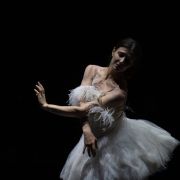
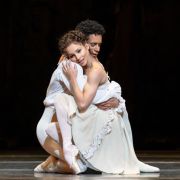
Sir Peter Wright and Galina Samsova created their Swan Lake in 1981 for Birmingham Royal Ballet (then called Sadler’s Wells Royal Ballet). It was premiered at the Palace Theatre in Manchester and was immediately considered to be one of the best productions in the world. BRB’s current revival is part of celebrations to mark Wright’s centenary year.

Can you introduce yourself and tell us a little about your current role and responsibilities with Birmingham Royal Ballet?
My name is Céline Gittens and I’m a principal dancer with the Birmingham Royal Ballet. I joined the company in 2006 under the Directorship of Sir David Bintley and was promoted to principal in 2016. Alongside Odette/Odile in Swan Lake, my notable roles with BRB include Juliet (Romeo and Juliet), Swanhilda (Coppélia), Lise (La Fille mal gardée), the Sugarplum Fairy (The Nutcracker), Striptease girl (Slaughter on 10th Avenue), Dark Angel (Serenade) and Aurora (The Sleeping Beauty). I have performed Odette/Odile in Sir Peter Wright’s production of Swan Lake with Tyrone Singleton, Brandon Lawrence, Vadim Muntagirov, Yasiel Hodelin (Act 2 and Act 3 pas de deux) and currently, with Mason King.
Swan Lake was first performed by the Bolshoi in 1877 and was deemed a failure. Since Petipa and Ivanov revived it in 1895 it has been one of the most performed ballets around the world. Why do you think its popularity has never waned and what are the elements that have made it so enduring?


Interestingly Petipa choreographed the technical brilliance in Act 1 and Act 3 and Ivanov mastered the ethereal atmosphere for Act 2 and Act 4. Both choreographic contributions created something that would withstand the test of time. However, I believe it was Tchaikovsky’s wonderful score that made this collaborative choreographic work a true masterpiece. The story is based on folklore and myth, which had been passed down through generations, and this could be one of the reasons for its continued interest.
Having a ballet that is based on folklore, gives these traditional stories a reality that is tangible, whereas the idea of such mythical stories would only be presented in an individual’s imagination. The popularity of the ballet probably grew because of the technical requirements and the fact that it was a privilege to witness the principal dancers do such wondrous pyrotechnics combined with artistic passion. The unison of the Swans is mesmerising and I could just imagine that the audience at the premiere performance were in complete awe of the synchronicity.

Even Tchaikovsky’s score was not considered successful at first yet for most of us it is a key element. How important is the music for you when you are dancing it and what are your favourite passages?
I adore Tchaikovsky’s music. I think that he really understood how to ‘feel’ music. My favourite part of the score is the whole of Act 4. The music is of betrayed love. It is as if the Swans all sensed what had happened at the end of Act 3. Act 4 shows a pensive state. Controlled and slow movements, all supported by the steady dramatic intensity building in the music.
You must have danced many roles in Swan Lake since you started your professional career with BRB two decades ago. What does the ballet still give to you in terms of new challenges/enjoyment?
I have recently been looking at previous videos of my Swan Lake performances and one that stood out to me was my debut on an international stage. Myself and dancing partner, Tyrone Singleton, performed the opening night of Swan Lake at the Bunka Kaikan Theatre in Tokyo, Japan. It was a triumphant performance and one that was also driven by the huge support of Sir David Bintley, Marion Tait and my colleagues. I now look at this video and discover ways that I can improve.
However, progression is a steady and constant devotion and you can only be as good as you are in that moment of your career. Moving through the ranks of the company and performing Waltz, Swans, Big Swans and Polish Princess, all built stamina. These are the roles one has to dance to develop a strong physical and mental foundation in a classical ballet company. Sir David Bintley had cast me as a cover for Odette/Odile in my second year with BRB to start building that mindset. I then debuted Odette/Odile 3 years later and became the first Black dancer in the United Kingdom to do so. It is so important not to push dancers too soon, even if they are exceptionally talented because we all have to professionally develop at the right time.


How has dancing in the corps de ballet and solo roles prepared you for the ultimate challenge of Odette/Odile?
Dancing in the corps de ballet and later in solo work, gave me stage experience. It is definitely not to be taken for granted. You start building a performance routine that is personal to your needs.
How do you feel in the moments before the first entrance of Odette?
The moment before Odette’s entrance is like being drawn into this folklore of long ago. Tchaikovsky was able to set the musical scene of Odette landing from the sky and from that point onwards, the drama steadily unfolds.

Do you have rituals/preparations that help you to get underneath the skin of Odette/Odile?
I often ask myself ‘what is this step or arm gesture really trying to say to the audience?’ Every step needs meaning and more so in a narrative ballet like Swan Lake. Steps should not just be there to fill the music, it is imperative for character development.
In what way has your approach to the role changed over the years?
My approach to the role hasn’t changed but the layers of my knowledge certainly add to a greater understanding of bringing Odette and Odile to life.

What are the most poignant moments in the ballet for you?
The most poignant moment is in Act 4 where Odette has given up hope, only to realise that Siegfried has returned to find her.
People often refer to the 32 fouettés as a significant achievement but in the context of the whole role they are a very small part of it. What are the most difficult challenges for you?
The most important aspect, aside from the choreographic technicalities, is completely embodying the character and also creating this feeling of an inseparable connection with Siegfried.

What makes Sir Peter Wright’s version so beautiful to dance (and watch)?
Sir Peter Wright’s productions of the Tchaikovsky classics have stood the test of time in their own right and have greatly succeeded. In 2025, the National Ballet of Japan created their own production of Sir Peter Wright’s Swan Lake. He is an icon of the ballet world and will forever inspire me with his unwavering passion for the arts and for Birmingham Royal Ballet.
See Birmingham Royal Ballet’s upcoming performances of Swan Lake.
This article was sponsored by Birmingham Royal Ballet