At this year’s Auckland Arts Festival, Bartók’s Duke Bluebeard’s Castle was given a very different focus, the familiar gothic allegory turned into something more modern and more unsettling in its examination of ageing and memory. Rather than Judith examining the horrors of her new husband Bluebeard’s past, Daisy Evans’ semi-staged production for New Zealand Opera instead reframes the opera as the story of an older couple dealing with Judith’s advanced dementia, a surprisingly but extremely effective take that brings out a moving and relatable humanity in the couple’s interactions.

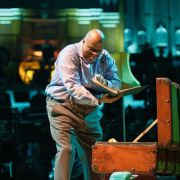
The Auckland Town Hall stage bears little resemblance to the forbidding castle of poet Béla Balázs’s libretto. Instead, Evans places the action inside the modest home of an ageing Bluebeard and Judith, chairs and lamps suggesting a familiar domestic interior. In the centre of the stage sits a large suitcase, serving as a proxy for the castle’s seven doors. Each time it is opened, another object emerges, mementoes representing events from the couple’s life together. With each object also appears an actor embodying a younger Judith, representing moments from her past: her wedding, family life and the devastating memory of her son’s funeral. Lighting design helps delineate the shifts between the different ‘doors’, bathing the stage in contrasting atmospheres as each memory emerges.
Instead of an obsession with Bluebeard’s dark past, in this version it is an obsession with rediscovering her own past, the memories that are slipping in and out of reach, that motivates Judith to relentlessly seek to open all seven doors. At first these recollections bring temporary happiness, but Judith’s inability to hold onto them as joyful memories soon becomes clear. As in Balázs’s original scenario, everything is overwhelmed by the vision of blood everywhere, a recurring image of trauma and guilt. In Evans’ staging, Judith’s repeated invocation of blood seems to represent her inability to hold on to the happiness contained therein.

The success of the concept rests squarely on its two singers, and both rose magnificently here to the challenge. Much of Bartók’s vocal writing is close to speech, and the conversational quality of the vocal lines demands exceptional clarity and expressive commitment. Susan Bullock had the full measure of this complicated interpretation of Judith’s role, every emotion visible on her face as well as in her voice, from confusion to happiness to grief. Her diction was wonderfully clear in Evans’ own English translation of the text, that one scarcely needed the supertitles when she was singing. Vocally, she was in very fine form with a rich lower register where much of Judith’s music lies, but also with an exhilarating high C at the opening of the fifth door that was cleanly approached and perfectly on pitch. Most harrowing of all was the moment of clarity that came upon her as she relived her son’s passing.

As her caring husband, Lester Lynch was a wonderfully human Bluebeard. Far from the aloof monarch of many Bluebeard’s Castles, he was a loving, devoted husband interacting with Judith’s memories and the actors as they emerged, with joy and with anguish. He conveyed love, but also a quiet dread, as he begged Judith to stop unleashing the memories as they became more and more traumatic for the both of them. Maybe sometimes his very lowest register ended up as something of a growl, but his is a major baritone voice that he utilised beautifully in warm, aching phrasing. The final ‘door’ – here a mirror that Judith holds up to herself – is an especially poignant moment, as she sees the woman Bluebeard loved all of his life.
Situated behind the singers, the Auckland Philharmonia delivered playing of exceptional colour under Brad Cohen, who clearly has a firm grasp of Bartók’s volatile score, with its ongoing tension. The performance moved seamlessly between eerie sparkle and ominous darkness, always maintaining an undercurrent of unease. The famous opening of the fifth door brought thrilling brass and magnificent organ sonorities, while elsewhere the adept percussion added an unsettling edge.
In Evans’ hands, Duke Bluebeard’s Castle becomes less a fairy tale or horror story than a meditation on the challenges of love through memory’s collapse. In this conception, as Judith briefly reconnects with the joy and tragedy of her life, the effect is nothing short of devastating.
This review was amended to correct a point about the length of the high C at the opening of Door 5, which is only two beats long in the score.