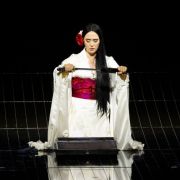
Madama Butterfly was composed in 1904, following a cultural phenomenon called japonisme, which idealised the countries of the Far East and expressed the Western world’s fascination with their ‘exotic’ cultures. This fascination arose in the context of colonialism. Even though Japan was never a colony, Americans and other Westerners lived in Japanese port cities under special conditions which granted them unique privileges and left them only formally subject to Japanese law.

The love story between young Japanese geisha Cio-Cio-San (Butterfly), and a US naval commander, B. F. Pinkerton, is the product of such a milieu. The marriage between the two is little more than a formality and nobody truly believes it to be a genuine, legal and committed union. Apart from Butterfly. Born into high society, her family had fallen into disgrace; her father was coerced into suicide, and she was forced to become a geisha in order to survive. She therefore sees her marriage to a powerful American as a chance for redemption, a way to regain her place in society. Pinkerton abandons her, as everyone except her expected, returning three years later with a “real American wife”, determined to take with him the son born to Butterfly in the meantime. The only honourable way out for her is suicide.
The late Anthony Minghella’s production, premiered at English National Opera in 2005, became an instant classic and has been performed all over the world with great success. Minghella brings his cinematic experience to the operatic stage with a production built around images, reflections and lines of sight. The large mirror at the back of the stage, tilted at a 45-degree angle, reflects the events as seen from above. It is not merely decorative, but a way of making the audience aware of their own act of seeing and interpreting: reality and projection coexist simultaneously, revealing our Western gaze in action. Minghella does not attempt to correct the historical Western interpretation by passing moral judgment on it, nor does he celebrate it uncritically. Instead, he exposes and describes the theatrical mechanism that exoticises and romanticises a foreign culture into spectacle. The Bunraku puppet representing Butterfly’s child can also be interpreted within this framework.

Michael Levine’s sets are minimalistic: a backdrop that changes colour depending on the scene, a raked platform descending toward the front of the stage, and rice-paper panels entering and exiting to represent Butterfly’s house, with only minimal props – a chair and some cushions. All attention is concentrated on the action and the expression of emotions, which Puccini’s score depicts without restraint. This is probably the most heart-wrenching music he ever wrote; it is almost shameless in its attempt to provoke visceral reactions.
Conductor Marco Armiliato gave a carefully considered interpretation of the score. Nothing felt routine; every phrase seemed polished and deeply felt. The woodwinds and brass were the protagonists of this reading, while the percussion was bold and decisive. The Vienna State Opera Orchestra produced a splendid sound, velvety, rich, with thrilling fortissimos. There were, however, some balance issues between pit and stage, with the singers occasionally drowned out by the orchestra. But it is easy to understand why: reining in this orchestra must feel almost like blasphemy.

Ermonela Jaho returned to her signature role as Butterfly. Her character development was superb: if in the first act she was a convincing 15-year-old, with a pure, lyrical sound, when portraying the mother her interpretation became visceral and raw, her voice pushed to the limits of its dramatic range. Her middle and low registers were resonant and deep, never forced, and her high notes cut through the darkness like steel. “Tu, tu, piccolo Iddio” was devastating, almost unbearable. Her most powerful tools, however, were her pianissimi: single threads of sound floating on her controlled breath, spinning rapidly, alive with harmonics, simply gorgeous.
Saimir Pirgu was Pinkerton, perhaps the most hated villain in opera (it is always amusing to watch first-time viewers of Butterfly huffing and puffing at him). His high notes were powerful, with the right macho colour, perfectly suited to the role. His more conversational singing was perhaps less successful, but he found the right emotional tone in the love duet, which came across as believable, passionate and moving. In the third act he delivered a beautiful interpretation of “Addio, fiorito asil”, despite it being one of the most infuriating arias in the entire repertoire.

Attila Mokus sang Sharpless, and he managed to make his role stand out with a smooth baritone and elegant delivery. His duet with Pirgu in the third act was very well interpreted, with beautiful phrasing. Suzuki, Butterfly’s maid and confidante, was Stephanie Maitland, whose mezzo was exceptionally well projected, her dark voice remarkably even throughout the range.