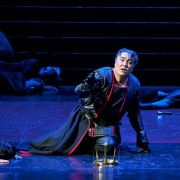
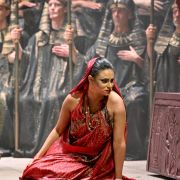
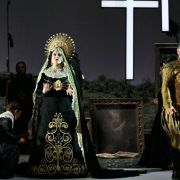
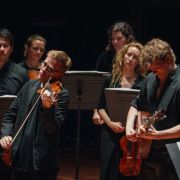
Over four centuries after his death, William Shakespeare remains an inexhaustible source of inspiration for composers. His plays – rich in psychological nuance, political intrigue and lyrical imagery – have inspired music across genres, from grand opera to tone poems, ballets to incidental music for the stage. Many of the Bard’s plays themselves contain songs, inviting further musical settings. While the tragedies have proved the most attractive plays to composers, the comedies and histories have generally fared less well.

Some composers follow Shakespeare’s narrative arc closely, as in operatic adaptations that preserve character and plot, while others distil a play’s essence into purely orchestral terms. This playlist brings together ten works – I’ve tried not to duplicate plays or composers – that capture the breadth of Shakespeare’s musical afterlife, spanning the centuries from the early Romantic imagination to 21st-century modernism, demonstrating how composers have continually rediscovered – and re-heard – the Bard. “If music be the food of love, play on; give me excess of it...”
1Mendelssohn: A Midsummer Night’s Dream
Shakespeare’s fairies, lovers and rustics inspired music from Henry Purcell’s masque The Fairy-Queen to Benjamin Britten’s opera, but the finest setting comes from the Romantic era. Felix Mendelssohn composed his overture to A Midsummer Night’s Dream when he was still in his teens. It is a remarkable distillation of Shakespeare’s play, conjuring up gossamer fairy magic and the clod-hopping “rude mechanicals”, including the braying of Bottom, transformed into a donkey. Then, 16 years later, he composed incidental music to accompany the play, slipping with ease back into the fairy world of his youthful overture.


2Prokofiev: Romeo and Juliet
Star-cross’d lovers Romeo and Juliet have inspired any number of composers, from Tchaikovsky and Gounod to Leonard Bernstein (West Side Story), but Sergei Prokofiev’s ballet has proved to be one of the best settings of Shakespeare for the dance stage. From the thrusting Dance of the Knights to the ardour of the Balcony Scene, it is packed with dramatic music, inspiring great choreographers from Sir Kenneth MacMillan to Rudolf Nureyev and John Neumeier. Here is Nureyev – as Romeo – with Margot Fonteyn’s Juliet in The Royal Ballet’s 1966 film adaptation of MacMillan's version.
3Verdi: Falstaff
Giuseppe Verdi was an avid Shakespeare reader, keeping an Italian translation of the plays by his bedside. Three of his operas are based on the Bard. The early Macbeth, which he later revised, is a very fine work, but his final two operas – Otello and Falstaff – are absolute masterpieces, both featuring libretti superbly crafted by Arrigo Boito. Otello contains one of the most demanding tenor roles in the entire repertoire, and is the equal of Shakespeare’s play; but Falstaff, a wonderful ensemble piece, far transcends the original Shakespeare material (The Merry Wives of Windsor and bits of Henry IV). Alas, a fourth opera, King Lear, never came to be.
4Vaughan Williams: Serenade to Music
"How sweet the moonlight sleeps upon this bank!" Ralph Vaughan Williams’ Serenade to Music is a setting of Lorenzo’s lines from Act 5 of The Merchant of Venice. It was written as a tribute to conductor Sir Henry Wood, originally composed for 16 singers, each of whom is given a solo passage, but it is often performed – as here – in a version for chorus and orchestra. The music also features a prominent violin solo. It premiered at a concert in the Royal Albert Hall in 1938, in which Sergei Rachmaninov performed his Second Piano Concerto. When he heard the Serenade, Rachmaninov was moved to tears.
5Tchaikovsky: Hamlet
Tchaikovsky mined Shakespeare for three concert works. The fantasy-overture Romeo and Juliet is the best-known, but he also composed The Tempest and Hamlet. The latter does not follow the action of the play, but is rather a psychological depiction of the tormented title character. From the opening timpani roll and lamenting strings, we’re in no doubt about the tragedy about to unfold. There’s an oboe theme (Ophelia?) and a brassy march as motifs clash, Hamlet staring into the abyss.
6Dvořák: Othello
Antonín Dvořák’s concert overture Othello (1891) is a brilliant evocation of Shakespeare’s play – dark, brooding and passionate. Jealousy pulses through the musical depiction of Othello and Desdemona. Perhaps Dvořák knew Verdi’s opera, which had premiered in 1887, because the double bass writing in his overture is remarkably similar to the scene in Verdi’s Act 4, following Desdemona’s Ave Maria when Otello comes in to murder her.
7Finzi: Let Us Garlands Bring
In 1942, Gerald Finzi gathered together five settings of Shakespeare songs under the title Let Us Garlands Bring (the last line of Who is Silvia?) and dedicated them to Ralph Vaughan Williams for his 70th birthday. They’re beautiful settings, contrasting elegies with love songs. The most moving is Fear No More the Heat o' the Sun from Shakespeare’s Cymbeline, which RVW thought was one of the loveliest songs ever written.


8Berlioz: Le Roi Lear
In 1827, Hector Berlioz saw a company of English actors perform Hamlet at the Odéon Theatre in Paris. He was much taken with the Bard, but also with the Irish actress Harriet Smithson, who played Ophelia, triggering an obsession charted musically in his Symphonie fantastique. Shakespeare also became something of an obsession, leading to works including the overture King Lear, a compact work which opens darkly and dramatically. Berlioz left no detailed description, but the oboe melody could easily stand for Cordelia. For Lear’s madness, Berlioz wrote, “I only intended to portray it towards the middle of the allegro when the lower strings take up the theme of the introduction during the storm.”
9Barber: Antony and Cleopatra
Like Benjamin Britten and Peter Pears in A Midsummer Night’s Dream, Franco Zeffirelli’s libretto to Antony and Cleopatra exclusively uses Shakespeare’s verse. Samuel Barber’s opera was commissioned to open the new Metropolitan Opera House in 1966 and was a vehicle for the great soprano Leontyne Price, who created the role of Cleopatra. The gigantic staging – typical Zeffirelli – proved problematic. During the dress rehearsal, Price famously became trapped in a giant hydraulic pyramid. Barber later revised the opera, but it never enjoyed wide success, which is a pity. Only two scenes for Cleopatra have entered the repertory (“Give me my robe” excerpted below). In 2022, a new Antony and Cleopatra, composed by John Adams, premiered. Perhaps it will enjoy better fortunes.
10Adès: The Tempest
Thomas Adès’ second opera (2004) is set to a libretto by Meredith Oakes which drastically paraphrases Shakespeare’s text, condensing it to near-rhyming couplets. The action centres on Prospero, the deposed Duke of Milan, living in exile on the island with his daughter, Miranda. In Prospero’s power is the spirit Ariel, a role sung by a coloratura soprano, who has high-wire vocal lines written in an extremely high tessitura. Think of Mozart’s Queen of the Night on helium!
Bonus: Cole Porter: Kiss Me, Kate
Aside from West Side Story, one of the best musicals based on Shakespeare is Cole Porter’s Kiss Me, Kate, a riotous setting of the comedy The Taming of the Shrew. It contains the hit songs “Another Op'nin', Another Show”, “Too Darn Hot” and the entertaining duet for two gangsters, “Brush Up Your Shakespeare”.