Erich Wolfgang Korngold’s genius showed itself early. At just 18 years old, his opera Violanta – along with a much more cheerful piece, Der Ring des Polykrates – was premiered in Munich in 1916. Now Deutsche Oper Berlin, as part of its Korngold cycle, presents a new production, directed by David Hermann and conducted by Sir Donald Runnicles.

Venice during carnival season: Violanta is obsessed in her desire to kill Prince Alfonso, who once seduced her sister and drove her to suicide. She recognises him in the revelling crowd and lures him to her home for a rendezvous. While waiting for him, she manages to convince her husband Simone to commit the murder, so that she can love him again. But the encounter does not go as planned. Violanta becomes attracted to Alfonso, and her erotic fantasies and a longing for death become inextricably intertwined.
Deutsche Oper Berlin decided to extend Korngold’s one-act score, which lasts just under 70 minutes, with an orchestral ‘prologue’: John Dowland's lute piece A Fancy, composed in the 16th century – a work that plays with elegant, almost improvisational freedom – and the Prelude from Alban Berg's Three Orchestral Pieces, Op.6, written at around the same time as Korngold's Violanta itself, which opens up a different expressionistic soundscape that anticipates the inner turmoil of the opera that follows.


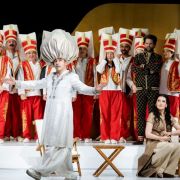
David Hermann’s interpretation goes beyond a mere love triangle. He reveals a Janus-faced narrative about a woman who hides an existential desire for sexual fulfilment, guilt and desire, behind the façade of revenge. These urges drive the psychological drama with orchestral exuberance. Jo Schramm's stage design concentrates this inner conflict into a set that is powerfully focused: a minimalist platform traversed by a walk-in, spiralling screw. This architectural form, with dramatic lighting by Ulrich Niepel, becomes a visible symbol of Violanta's mental state. The characters move on this construction as if on a psychological staircase with the possibility of ascending and descending in emotional entanglement. This interpretation lends the work a surprising modernity: all the characters tell – explicitly or implicitly – of their problems, their fractures, their inability to find a coherent self. Alfonso is not portrayed as a demonic seducer, but as a Freudian projection screen, complete with notebook and pencil.

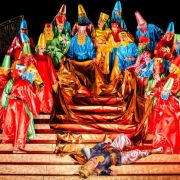
Sybille Wallum's costumes are imaginative, elegant and in subtle shades of purple, creating a poetic counterpoint to the sober space. After all, violet and purple have long been considered colours of ambivalence and emotional intensity for centuries. They lend the characters aura and theatricality, while at the same time underlining the emotional charge of the evening. Violanta in particular is given a visual presence by this colour dramaturgy that reflects her inner fervour.
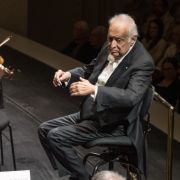
Musically, it is astonishing how cohesive Korngold's language already is in this early work. Violanta already contains all the characteristics that define his later works: the large orchestral palette, the dazzling richness of colour, the characteristic harp glissandi, the glittering melodies. Korngold’s music makes psychological states audible, intensifies them, lays them bare. Runnicles masterfully conducted the orchestra, which was in fine form, and emphasised the artistry of the instrumentation and the modernity of the score with confidently interpreted tempi.


The vocal focus was American soprano Laura Wilde in the title role. Korngold demands a virtuoso performance here, requiring power, flexibility and an enormous range of expression. Wilde met these requirements while also conveying fine intimacy. Her Violanta’s inner turmoil was inscribed in every note.
Latvian tenor Mihail Culpajevs was not a seducer with mellowness and finesse. Korngold prescribes that the part should remain in a state of constant tenor excitement, and Culpajevs fulfilled this dictum perfectly. In contrast, Icelandic baritone Ólafur Sigurdarson was the most likeable as the pitiful husband Simone. With his warm timbre and precise characterisation, he gave a remarkable performance. As Violanta's nurse, mezzo-soprano Stephanie Wake-Edwards attracted attention with her acting and singing, as did tenor Andrei Danilov as Matteo, who is in love with Violanta.
The Deutsche Oper Chorus performed entirely off-stage and thus seemed otherworldly. In stark contrast, the dancers of the Deutsche Oper Ballet were very much of this world, evoking carnivalesque tableaux with their pointed hats. The result was an evening that took Korngold's Violanta seriously for what it is: an early but astonishingly mature psychodrama.