The news of a Salvatore Sciarrino performance in New York City comes with a sharp inhalation that is quickly met with the better realization of how rare the opportunity is. It's with thanks to forward-thinking American Modern Opera Company (and not even half a handful of others) that it happens at all. The composer has an enthralling way of making music that is at once cohesive and disjointed. Isolated tones become fragments of phrases than fracture again.

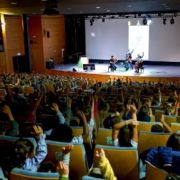
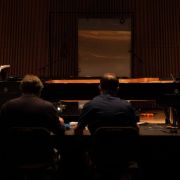
Part of Time:Spans festival, six music stands were set in a wide array across the staging ground in front of a substantial percussion rig at the DiMenna Center for Classical Music. Baritone Ty Bouque began Sciarrino's set of songs in what could have been a sputtered madrigal, accompanied in short order by sparse long tones from flute, violin and eventually bowed cymbals, all the musicians dressed in white. Stupori (composed in 2008) bears the subtitle ‘six readable silences’ and borrows from Bashō, the Old Testament and graffiti.


However disassembled it might have seemed, the 30-minute suite was a wonderful vehicle for Bouque, who was repeatedly called upon to jump registers while flipping dynamics, moving from stand to stand for each song. His voice commanded attention, but the mix was in flux, physically adjusted, as he moved from one stand to another. To say he did it with ease would be to sell him short; he did it with focus and determination.
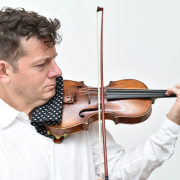
Emi Ferguson showed fantastic breath control through the flute (Sciarrino loves a loud whisper) and Miranda Cuckson shifted between tonal qualities in what seemed like an infinity of incidentals. The percussion was so occasional that it seemed it couldn’t have been counted, Johnny Allen more likely following cues like an actor than a timekeeper. Unexpected crashes punctuated the penultimate song, after which Bouque set himself front and center, facing the audience, with the first appearance of tuned percussion (a marimba) and text that came in blocks, very nearly like verses, but briefly, bringing the set to conclusion.
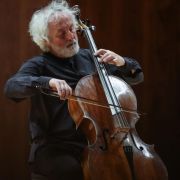
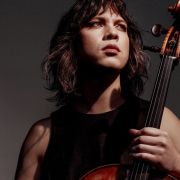
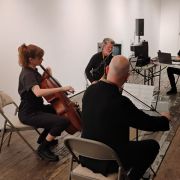
At about an hour, Michael Hirsch's Carrion-Miles to Purgatory: thirteen pieces after texts of Robert Lowell (2014) was roughly double the length of the Sciarrino and an even deeper immersion. This time the texts were unsung, but served as inspiration for violin (Cuckson) and cello (Coleman Itzkoff). The music felt ancient but delicate, a centuries-old piece of lace that retains its pattern, a tree growing from the side of an arid, rocky cliff. When harmonic intervals began to distinguish themselves within the elliptical lines, it was intoxicating. When lines became phrases, in near unison and close harmony, it was enthralling. When the players paused, the sound space filled with anticipation as to what sculpture might next be made from the same materials. Beautifully long passages contained wonders. It was a feast prepared for speculation and inquisition, and It was all together odd how lovely it was. Again dynamics were the invisible member of the ensemble, and the acoustics in Mary Flager Cary Hall supported it at every turn. The dynamics fluctuated wildly but the strings were always in sync. However closely aligned the notes on the page were at any given moment, the momentum was palpable.


Interestingly, both the Sciarrino and Hersch works concluded with slight nods to convention. A longer pause proceeded the final section of Carrion-Miles – a lovely ballad, harmonically and metrically more uniform than what preceded. It was mournful and beautiful, time slowing and offering resolution, like a feeling of home, like we lived here now.