If I were asked to sum up Septime Webre’s signature style in one word, I’d likely say maximalist. Who therefore could be more fitting to choreograph The Great Gatsby? Premiered in Hong Kong in 2019, it made a dazzling debut at Kansas City Ballet tonight.

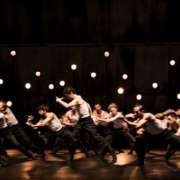
It’s a hundred years since the roaring 20s, and Webre makes them roar all over. The music, composed, compiled and arranged by Billy Novick and played by his band, the Blue Syncopators, certainly helps. Vocals by jazz artists, Eboni Fondren and Tanner Rose (in the pit and on stage), and a stand-alone tap-dancing routine by Lonnie McFadden enhances the no-holds-barred atmosphere, making the whole into a show, not simply a ballet. High-octane performances from the corps in the unforgettable party scenes, all swinging limbs and busy footwork, leave us breathlessly mouthing the famous Yeatsian quandary: ‘How can we know the dancer from the dance?’


There’s also a street scene smack in the middle of Act 1, where Webre goes all out. Think the black-and-white aesthetic of Cecil Beaton’s Ascot scene, but instead of stiff upper-crust Britons, substitute the pulsing humanity of NYC: flappers, burglars, cops, baseball players, sailors, a millionaire, schoolgirls, newspaper boys, and oh yes, a nun encountering a rabbi. It’s so quick you might even miss it – but there it is, a few seconds of the pleasurably unexpected, as the two lock heads over scripture. This is New York, after all. Anything is possible, reimagined in dance: classic Webre.

Webre makes voyeurism pleasurable, we can’t deny it. From the very beginning, we, the audience, are positioned outside the finely-wrought gates of the Gatsby mansion, and from then on, it’s an open-and-shut world, as we learn which doors open onto which dazzling parties, which windows open onto which views (picture-perfect beaches or smokey chimneys or red light district), what curtains disclose or conceal.
In one fabulous bit of choreography at the start of Act 2, we glimpse disembodied legs dancing under a curtain. You can tell a lot from just legs. These are maids and butlers – who are omnipresent throughout, incidentally, making the lives of the rich happen and supplying the endless drinks, and so here we are again, complicit voyeurs all.

The sets and costumes, courtesy of Tim Yip, are gorgeous to behold from the gleaming geometries of Shanghai-style Art Deco to the gaudy glamor of Tom’s mistress’ apartment in New York. Contrast that with the industrial underbelly of the city, where men in denim overalls and tank-tops, work by the sweat of their brow (a great muscular routine from the corps). Paul Zusi, as George, seemed to have an internal spring in him that gave all his movements an extra force. As the anti-lyrical, anti-leisurely character, his movements were that of industrial man in motion. That his world comes together with Gatsby’s, with all its swirls and twirls, is the work’s central tragic irony.


Cameron Thomas as Tom was powerfully dominant in the space, like the Alpha male he wants to be. Andrew Vecseri caught the swirling lyricism of Gatsby’s movements (if not always the profound melancholy) and Kaleena Burks was an elegant Daisy. I loved how their pas de deux (four in total, including the flash-back) went from more conventional to their final boundary-pushing one, as their affair became bolder. Joshua Kiesel and Taryn Pachciarz as Nick Caraway and Jordan Baker were a lively pairing; their neat pas de deux with a golf club was delightful, just as Kiesel’s original boulevardier dance with his umbrella had been.
The production played up the idea of dancing as literal and moral transgression. Take, for example, the moment we first discover Tom and Myrtle’s affair. She’s in a telephone booth at one side of the stage, and he’s on his landline on the other side, and they are both dancing out their ‘affair’ in conversation. Naomi Tanioka as Myrtle, Tom’s ‘bit of rough’, was a revelation. Never has she impressed more. All drive, sensuality and abandon, she played on the edge of danger and perfectly epitomized the liberation Tom sought from the stylized, bourgeois world.

For truth be told, despite all the privileges and those parties, the bright young things are deathly bored. Early on, when Daisy, Tom, Nick and Jordan all collapse on the impeccable white sofa, in sudden existential disarray, all four arms stretch out for another cocktail – cue the maids (one per person) and the scene blacks out. It’s brilliantly funny and very dark. Drink more, dance more. There’s nothing else.
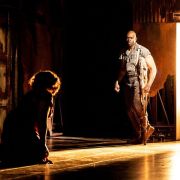
Darkest of all is the last scene, made cinematic by withdrawing music. Only percussion remain – the beating heart of the demented widower (Zusi) and the fatal gunshot. Gatsby, notably, has no ballet shoes on as he falls dead. The party is finally over. The dance is done.