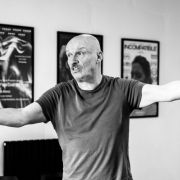
James Gaffigan spends most his time in Europe. He’s currently in Berlin, where is the Music Director of the Komische Oper Berlin – his contract has recently been renewed through 2030. He has been preparing for the new production of Shostakovich’s Lady Macbeth of Mtsensk directed by Barrie Kosky. He has also just finished his tenure as music director of Valencia’s Palau de les Arts, and has had stints with orchestras in Switzerland, Germany, Norway, and the Netherlands. But his big return to the US awaits: he’s just been announced as Houston Grand Opera’s next music director, starting from the 2027–28 season.

For a conductor who has had so much success in Europe, why the US, and why now? “It’s a very long answer,” Gaffigan sighs. “The short version of it is that I grew up in the US. I moved out to Europe in my early twenties, and I’ve always had it in the back of my mind to come back somehow. I know the United States has a bad reputation right now, but in the end of the day I think the people make the country, and not the leadership.”
“I knew I wanted to make a big statement when I came back, and there have been some opportunities with various orchestras. But the Houston opportunity was special: it’s an incredibly forward-thinking institution, it has an incredible audience and donor base, and it’s extremely healthy financially. The Metropolitan Opera is in the news all the time – it’s such a large institution and they have so many bills to pay and so, so much money to raise. It’s almost an impossible task. But I love what [Houston Grand Opera General Director] Khori Dastoor is doing there already, and I love many colleagues who are already working there.”
The Houston Grand Opera position is in some ways a homecoming for Gaffigan, who studied at Rice University’s Shepherd School of Music. Are there any fond memories of his student days in Houston? “The food!” he enthuses. “There was incredible Asian food – Vietnamese, Szechuan, Cantonese, and so on. But barbecue was a whole new religion of food, and I truly loved it. I loved how Houston has this community feel, one where it’s important to experience food together.”


“When I was young I had very different aspirations about life. I made fun of suburbia, I made fun of driving a car, and I wanted to live in a big city. But as time goes on life happens: family, divorces, and so on. And what ends up being the most important is having a community behind you, having people who believe in you and want to take care of you. And I find that very strong in Houston. I feel like I’ve been accepted into this family, and it feels real.”
Most people think of Houston as a city of sports, as the home to five major professional league teams. “I think there are lots of misconceptions about Texas, especially about Houston,” Gaffigan muses, “and I think many people who go there are surprised. It’s a city that wants culture – not just opera, but symphonic music, museums, and so on. There’s the incredible Asia Society Center, the Rothko Chapel, the Menil Collection. All of this is geared towards giving the people of Houston extraordinary culture”
“But music has a lot to learn from the sports world,” he adds. “The biggest difference is that music isn’t a competition – I’m so thankful that when I’m conducting nobody is booing or wanting to see me fail. But I love how people gather behind a sports team, even in a bad season. The public really gets to know the athletes, and I think it’s something we don’t do enough of in the music world. We don’t get to know the people onstage – not just the star soprano or tenor, but the stage manager and the second bassoonist and so on. I think people gravitate towards people, and that’s one of the reasons people love sports.”

Gaffigan has just finished up his run as the music director of Valencia’s Palau de les Arts, a position he held for four seasons. “It’s an interesting European opera house, because it’s very new. It was originally led by Lorin Maazel and Zubin Mehta, and there was a lot of money flowing into it. The musicians were all handpicked all at the same time in their mid-twenties and there’s natural turnover, so my role was to refresh the orchestra and I’m very proud of the diverse group of people we hired.”
Under Gaffigan’s leadership, the orchestra quickly gained a reputation as one of the best opera orchestras in Europe. How does he go about developing an orchestra’s sound and repertoire? “It’s like gardening: you don’t only just plant gorgeous flowers and beautiful trees. You need to get in the dirt, fertilize it, pick out the weeds. There’s a lot of dirty stuff you need to do, and I enjoy that kind of work because I see the development and I take pride in that. And I think the musicians do too! I love the orchestra and the institution, and I’m looking forward to doing Salome there in the spring.”
Before his tenure in Valencia Gaffigan spent over a decade with the Lucerne Symphony Orchestra, where he championed repertoire by Wolfgang Rihm and Henri Dutilleux. What role does repertoire play in shaping an orchestra and its public? “You’ve just hit on two very big points: there’s the development of the orchestra and of the public. And with both you have to gain their trust. When I started in Lucerne, there were people approaching me in the market while I was shopping and come up to me and ask why I was programming Rihm or even Bartók. But with time you gain their trust, and they’re going to come no matter the repertoire.”
“In the US we have an obsession with selling classical music with a name. But I think this is dangerous, because it’s not about the music – it’s about flashy marketing. But there are certain composers that are more difficult than others, for some reason. Janáček, for instance, or Berg – I don’t know anyone who has seen Jenůfa or Wozzeck and hated it. But getting people in the door is the problem.”


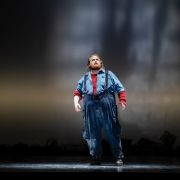
Gaffigan is also music director of the Komische Oper Berlin, where he works closely with director and former intendant Barrie Kosky – when I talk to Gaffigan he is deep in rehearsals for the new production of Shostakovich’s Lady Macbeth of Mtsensk, while conducting a revival of Kosky’s Eugene Onegin. “Barrie is one of my favourite people to work with! He’s so fun and he also understands music so deeply.
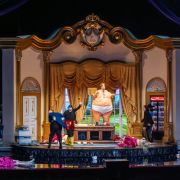
“This new production of Lady Macbeth is absolutely extraordinary: it’s haunting and beautiful and terribly depressing. It’s not romantic work all the time: it’s so detail-oriented and there are so many things to handle, from the sets and lighting and makeup to our extraordinary chorus, but I truly enjoy it. And on the flip side, we just did a revival of Barrie’s Onegin cast from within our ensemble. We had Penny [Sofroniadou] and Hubert [Zapiór] making their role debuts with so few rehearsals, and I was so proud. The German opera house system is a lot, and you have to love the insanity of it!”
The Komische Oper is unusually broad in its repertoire: the remainder of its 2025–26 season includes everything from Handel’s Belshazzar to Neuwirth’s Orlando to My Fair Lady. “When we choose repertoire and productions we do it for the complete opposite reason that most American institutions would,” Gaffigan explains. “In Berlin we have two other opera houses, and we can’t do the repertoire that the Staatsoper Berlin is doing regularly because there’s no public for that. So if we do a Bohème, we have to do a different type of Bohème. These are things I can only really do at the Komische Oper, and that’s important to me because there’s too much repertoire out there to be repeating the same twenty operas all the time.”
As different as the Komische Oper Berlin and Houston Grand Opera may seem, they both regularly present musicals in addition to opera. “I sometimes get very nasty responses about that!” Gaffigan tells me. “But I think good music is good music. In an American context, we have things like Porgy and Bess, Sweeney Todd, My Fair Lady, all of Rodgers and Hammerstein’s works I just think that if it’s theatrical and it has music and it’s good, it should be performed whether it’s musical theatre, operetta, or cabaret.”

Where does new work fall into this? “What’s interesting is that Houston Grand Opera has been known for commissioning new operas since the Gockley era. But how many of these works have been repeated again? I think it’s an institution’s duty to make sure others repeat this work, whether that means raising more money, tag-teaming with another presenter, or making a promise that you’re going to perform the piece more than once in the future.”
“Not to draw on food comparisons too much,” he laughs, “but it’s like when a new restaurant opens. Everyone looks at reviews and pictures to get an idea of what the food is going to be like. So I would very much like, when I do my first premiere, to do just that: get a famous singer to record a minute of the new score for social media, or do a public orchestra reading early on. Most people don’t walk into a restaurant without knowing what they’re going to serve you!”