Years ago, when I took my first Music History class at university, I made the ill-advised decision to prepare with one final big revision just before the exam. What I had calculated to be quick and painless snowballed into two days spent burning through a hefty textbook where Mozart and Wagner were only a few hours of reading apart. I passed the exam and swore to myself to never do anything like that again. Since then, I have proudly kept the oath – or at least I had until attending the German premiere of Olga Neuwirth’s Orlando at the Komische Oper. Based on Virginia Woolf’s 1928 novel, Neuwirth’s work is a three-hour compendium of Western (music) history whose ambitions are – much like mine of yore – commendable, but overly optimistic.

Orlando’s German makeover after its Wiener Staatsoper debut in 2019 is a dedicated one. The programme notes sizzle with enthusiasm from the cast, led by mezzo Ema Nikolovska and conductor Johannas Kalitzke. Indeed, for a good part of the opera such enthusiasm is warranted. But at the risk of sounding like Woolf’s petty critic Mr Greene, as soon as Neuwirth and her librettist Catherine Filloux bypass the novel's conclusion and venture into the uncharted territory of post-World War 2 events, Orlando loses its footing and languishes.
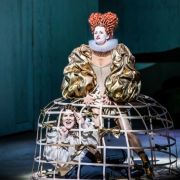
Ewelina Marciniak’s production reflects the core of Orlando, which is the inexhaustible fluidity of genres and genders. Starting from an unadorned ‘room of one’s own’ which Orlando and the Narrator – who resembles Woolf herself – use as private quarters to write, Marciniak envisions ever-changing surroundings. At the beginning, Orlando’s beloved oak tree fills the stage as a symbol of his connection to nature, untameable and perpetually renewing itself. When the tree falls after Orlando’s first heartbreak, background projections and the movement of singers, dancers and extras keep things in constant motion, enhanced by Julia Kornacka's chronologically disparate costumes. Concurrent levels of action between characters correspond to the complexity of Neuwirth’s work, which simultaneously stages the plot and the act of narrating it.

In Woolf’s novel, this meta-layer works as a witty literary device; in the opera, it ends up weighing on audience and director alike. When Neuwirth’s voice is heard at its clearest, denouncing right-wing extremism and calling for queer liberation, is also when Marciniak’s staging is at its least emotional and effective, reverting to clichés. Within Orlando’s hyperaware frame, however, some poignant moments shine through, allowing the director to explore the characters’ vulnerability through moments of physical intimacy – consensual or not.
If, according to Mahler, a symphony is “like the world: it must contain everything,” Neuwirth very nearly achieves that with her opera. The orchestration alone features a large ensemble with two choruses, on-stage musicians, unusual percussion, a sampler, a rock band and different tunings at once. On top of that, Neuwirth’s idiom is omnivorous, blending music styles from virtually any historical period and thriving on citations.

Kalitzke found a good theatrical pace in this cosmos. Rather than trying to simplify the score’s intricacy, he maintained its contradictions and used them to build coherent narrative arcs. Anything was possible and welcome: electric guitars accompanying madrigals, harpsichords playing Lady Gaga, or a person living for centuries as both man and woman. Timbral mixtures and unresolved dissonances were highlighted like Neuwirth intended, a manifesto for inclusion. At the same time, Orlando is a postmodern grand opéra centred on spectacle and extravaganza. The Orchestra of the Komische Oper sustained the prolonged rhythmic drive of certain choreographed scenes in some of the evening’s best moments.
Surprisingly, the rich orchestral wildlife doen’t find an equivalent in the opera’s vocal lines. Neuwirth’s characters tend towards a melismatic, often broken way of singing, and while they do update their style according to changing times, the characterisation isn’t exactly engaging. The most noticeable blind spot is Orlando him/herself, who as a man insists on the low register and as a woman moves higher in her range, effectively falling back on a traditional gender binary.

Unfortunately, having microphones on all the singers didn’t help convey more subtle nuances. Nonetheless, Ema Nikolovska’s Orlando made a positive impression thanks to her warm mezzo, finely controlled vibrato and a chameleonic sense of different music styles. Her stage presence, veered towards the youthful and idealistic of a typical mezzo role, was also convincing. Next to her, Alma Sadé played a somewhat stiff Narrator with an unsteady British accent, not quite living up to the multifaceted nature of her character. Countertenor Eric Jurenas and Kevin(a) Taylor gave good performances as the Guardian Angel and Orlando’s Child, Jurenas in particular proving himself a worthy heir to Jimmy Somerville in Sally Potter’s ingenious movie adaptation of Orlando.