Competitions are hardly renowned as relaxed environments, but Nemanja Radulović has nothing but warm memories of his triumph at the 2001 George Enescu International Competition. Wreathed in smiles on a video call from his hotel room in Porto, the Serbian-French violinist recalls hanging out with his fellow competitors in Bucharest, playing to them in practice and they to him, willing each other on. “We really tried to support each other.”

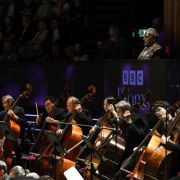
Back in 2001, the Competition took place at the same time as the George Enescu Festival, and Radulović took time out between rounds to enjoy concerts: he gives another beaming smile as he recalls Sarah Chang playing the Bruch G minor Concerto. These days, the Competition and Festival are scheduled in alternate years, and thus throughout each September, the month-long event takes front and centre stage in Romania’s flourishing cultural life.
Entries are now open, until 10th May, for the instrumental divisions of the 2026 competition, its 20th edition. Violinists, cellists and pianists under the age of 35 will compete for shares of a total prize pot worth around €150,000, including a first prize in each division of €15,000, and numerous other awards such as the best performance of a piece by Enescu. A division for composers (under 35) is open for entry until 30 June, and awards prizes in symphonic and chamber categories as well as a ‘Special Prize for Originality’.

The composition division is one of several innovations introduced to the George Enescu Festival and Competition in recent years. When I talked to artistic director Cristian Măcelaru before the last competition two years ago, and then again at the event itself, the Romanian conductor was at pains to emphasise that the financial prizes, while valuable in themselves, constitute a minor component of the rationale behind the competition. It is the journey that counts, he says, not the arrival, whether a young musician gets first prize or goes home early: the experience of learning new repertoire, preparing it to the highest standard, then playing it in front of an international jury and learning from fellow competitors.


Radulović heartily echoes these sentiments. “My vision of the competition was not to compete. I know it sounds crazy – and each musician’s motivation will be individual. I see it as a platform for them to prepare and play so much different repertoire in such a short time. This is a luxury, I think, for every young musician, and I say to my students that they should go, go, go: go to as many competitions as they can. Even if it doesn’t work out, if you don’t make it to the finals or get the top prize, it doesn’t matter. You will meet people. You will have a much stronger idea of the repertoire you’re playing. I think the experience can only be positive.”
In Bucharest, at the Enescu Competition, there is the added pleasure of performing in the gloriously ornate, circular domed Athenaeum: “It’s such a special hall,” says Radulović, “because the audience is almost surrounding you, and you feel you are sharing the music with them.” When the violinist carried off first prize there in 2001, it was with the Beethoven Concerto, which he had never previously played in competition. Yet Radulović felt the stars aligned, as perhaps they must for every young musician at a turning point in their lives. “It was my favourite piece. I had grown up listening to Isaac Stern’s version. And during the final it turned out that Stern had passed away in New York. I felt so sad when I heard, but also even more connected to the piece, because I had always been so thankful for his artistry.”

In a more dirct way, Radulović still feels gratitude for the coaching of his teacher at the time, Patrice Fontarosa. “I especially remember the Enescu Competition because of playing the Third Violin Sonata of Enescu. Patrice had talked to me about Enescu, and he said, ‘Now is the right time for you to meet this music.’ And it has been close to me ever since.” Each instrumental entrant must bring at least one of Enescu’s major works to the competition. Encountering them one after another, as I found during the piano finals in 2024, is an exhilarating experience, and anyone who gets under the composer’s skin will want to share their new-found enthusiasm with others.
While the surface complexity of Enescu’s language still proves challenging for musicians and audiences outside Romania, the Serbian Radulović feels a neighbourly affinity with its asymmetrical rhythms and long, rhapsodic melodies. “This is music that speaks to me. But for musicians from farther away, perhaps it’s easier to learn now than even a generation ago, because there are so many more recordings.”
Prize-winners at the Enescu Competition are invited to perform at the following year’s festival; Radulović has returned to Bucharest on several occasions, such as the opening concert of the spectacular 2025 edition of the festival, when he played the Violin Concerto by Khachaturian which he is rehearsing in Porto when we speak. At the 2021 Enescu Festival, he played Prokofiev’s Second Violin Concerto which also introduces his new album on Warner Classics. In concert and on record, Radulović was partnered by Santtu-Matias Rouvali; the Finnish conductor will also accompany the violinist when he plays the concerto at the Bravo! Vail festival in Colorado in July, following several other performances in Belgium, France, Australia and South Korea.
Radulović talks about the contrasting characters of the Concerto’s three movements – and within them – and I’m reminded of Prokofiev the grand master at chess, also of the “Masks” dance in Romeo. With a composer so adept at wearing masks, and thinking five steps ahead of you at all times, it can be hard to avoid asking the question: where is the true Prokofiev? “This is exactly the word I used in the booklet note for the album,” replies Radulović. “He is there, fully himself, in all these different characters, and this is the wondrous truth of Prokofiev.”


This intensity of engagement with Prokofiev is not merely well-timed to coincide with the new album; the Second Concerto has become as central to Radulović’s life and career as the Beethoven Concerto. He was introduced to it at the age of 12 by his teacher in Belgrade, Dejan Mihailović, who had studied with David Oistrakh. Initially fazed by the concerto’s opening solo, unsupported by the orchestra, the teenage virtuoso asked his teacher for advice. “And he said, don’t think, just start playing.”
Which, in one sense, is exactly what Radulović has gone on to do, with an unmistakably personal sound and style which feels peculiarly well-suited to the balletic, quicksilver and quasi-improvisatory sound-world of Prokofiev in the mid-1930s (contemporary with the Concerto, the Sonata for Two Violins and excerpts from Romeo and Juliet also feature on the album). At the same time, with age comes experience. “I can’t play the opening of the Concerto like that any more – or at least, I don’t. I’m singing that solo entry in my head before I start, to get the right tempo, to imagine the right sound.”
The demands of international competitions, however, do not tend to nurture such freedom of expression in their contestants. The violinist’s approach to Beethoven and Prokofiev has matured over the years; could he have won the Enescu Competition playing this way? Again he laughs. “Well – that was exactly the discussion I had with Patrice Fontanarosa. I was really lucky to have such a mentor, who wanted to help me to develop as the person I am inside, without putting any kind of limits on that. And while I was preparing the Enescu Sonata, since I had such a feeling for this music, I asked him: should I go more, or less? How should I play for the competition?”
Fontarosa’s reply? “He said: ‘You should play as you are. If you present yourself as someone you are not, then no one will recognise you when it’s all over. And there is no single way to play for the competition, because you will have ten or eleven judges, and they will all have different opinions. You cannot choose to play for this or that one.’ And this gave me the freedom I needed.” If the contestants in this year’s Enescu Competition can follow the example of Radulović, then they will have won a prize of personal fulfilment which may, in the long run, be worth more than a gold medal and a wodge of Euros.
Entry to the George Enescu International Competition 2026 is open until 10th May.
The Competition is held in Bucharest from 23rd August to 19th September.
Nemanja Radulović will participate as a jury member in the Violin competition from the semifinals, and is due to give a performance during the competition.
See upcoming performances by Nemanja Radulović.
This article was sponsored by Artexim – George Enescu International Competition and Festival