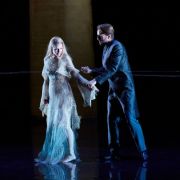
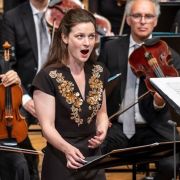
Louise Farrenc, Augusta Holmès and Clémence de Grandval might not be household names, but these lesser-known women composers have become crucial musical figures for Palazzetto Bru Zane. Over the past year, and in the coming months, the Palazzetto is running a series of performances focusing on Louise Farrenc. Meanwhile, a stage production of Clémence de Grandval’s grand opera Mazeppa will shortly appear in Dortmund in March, and Holmès’ La Montagne noire in Bordeaux in May.

A cultural institution with 19th-century French music at the heart of everything it does, Palazzetto Bru Zane is all at once a research centre, a record label, a publishing house and a concert producer. Its roots – and the Palazzetto itself – may be in Venice, but its productions and cultural ambitions stretch much further.
When we speak by video call, Bru Zane’s artistic director Alexandre Dratwicki and director of research and publications Étienne Jardin are at pains to emphasise that their interest in platforming female composers is nothing new. “In the last few years,” Dratwicki tells me, “we’ve been aware of this desire and necessity for programmers to rediscover music by women composers. But we didn’t wait for it to be in fashion to develop an interest.”
Nevertheless, the growing demand for works by women is something Bru Zane is well situated to answer. The research and editorial part of the equation is something many other programmers are ill-equipped to handle. Not so Bru Zane, whose researchers organise resources for performance, as well as creating publications and hosting talks, helping to answer the big questions that come up along the way. Bru Zane Label’s catalogue is also extensive, with Mazeppa and La Montagne noire released as CD-books in 2026 and 2027.

“If you really want to centre these composers, their most remarkable and certainly their most ambitious compositions are grand lyrical and symphonic works, which are obviously the most expensive and difficult to programme.” Dratwicki points out the tendency, in the last few years, to make space only for small-scale piano works or song cycles by women composers, “which keeps them boxed off in a parallel repertoire, a less ambitious one, which might seem to demonstrate certain limitations in terms of technical competency or orchestration.” Bru Zane wants to do something different, something bigger.


Dratwicki and Jardin take a panoramic view of the 19th century, “from Marie-Antoinette to the First World War”, which means including composers like marquise Hélène de Montgeroult, born at the end of the 18th century, all the way to Rita Strohl, who died in the 1940s. Other figures like Louise Bertin, Marie Jaëll and Mel Bonis are given the spotlight on a regular basis, both in specific festivals or concert cycles and in regular programming. Of paramount importance to the directors, Dratwicki explains, is to avoid treating women composers as a unified bloc, “as if they were all subject to the same issues, as if they’ve all been erased from history or obstructed during their lifetimes in the same way – or, even worse, as if they share a ‘feminine style’. What we want is to emphasise their individual personalities.”
The research he describes is painstaking and time-consuming, a labour of love: rummaging through archives, visiting the composers’ descendants, sifting through correspondence and sheet music, digitising reams of material, eventually working to assemble coherent editions for publication.
Palazzetto Bru Zane’s initial concert cycle also makes a conscious decision to step away from what they describe as the risk of “ghettoising” women composers. Rather, they prefer to think generationally – the children of the century, les enfants du siècle, in all their variety, evolving through the decades. According to Étienne Jardin, “this generation is usually seen as Berlioz and his contemporaries, but we wanted to shift that perspective, to reconsider these children who were born at the height of Napoleon’s grandeur and who went through the fall of the Empire in their youth, who went through all of these political changes that came to a head just as musical Romanticism was flowering. We decided that Louise Farrenc would be our common thread.”
Louise Farrenc, born 1804, stands at one end of the spectrum: a prize-winning composer in her time, a successful concert pianist and professor at the Paris Conservatoire, with relatively conservative (or classical) tastes, as well as institutional and familial support. Bru Zane’s cycle, in Venice from 28th March to 28th April, presents Farrenc’s varied work in dialogue with that of her contemporaries (Onslow, Berlioz) and inspirations (Beethoven). Of particular interest is the platforming of Farrenc’s symphonic works – all three of her symphonies and one of a pair of overtures – thus giving space to her most ambitious and imaginative compositions.
Farrenc’s work occupies an interesting position in her era. With her husband Aristide, she edited a wide array of piano works, an interest which no doubt shaped her own choices as a composer. In Dratwicki’s words, “She is clearly defending a kind of music which could be considered insignificant, she writes études, sonatas, quintets, classical works without titles… She doesn’t go into a certain kind of virtuosity, this visual explosion of complications, cross-handed technique, grand leaps across registers using the sustain pedal, because all of that is just spectacle, not thought.”
At the other end of the scale, firmly in the camp of spectacle, we have Augusta Holmès (b. 1847). Her opera La Montagne noire, a lyric drama set in Montenegro, is complete with dangerous mountains, forbidden love and a dash of Orientalism. Étienne Jardin is at pains to avoid overly simplistic notions of connection and inheritance between these composers. “I think that Augusta Holmès’ path is a very different one to Louise Farrenc, and her position in the musical world of her era is also very different.”
In Jardin’s words, Holmès is something of a self-made composer and free agent, who made a name for herself without the backing of any major institutions. Clearly, her approach had some success: both Debussy and Parisian writer Colette speak warmly of her work, and in 1889, she was chosen to write a piece for over a thousand musicians for that year’s Paris Exposition.
“In the history of women composers,” Jardin says with some amusement, “they are often described as creating small things, little pieces for piano, for the salon – this is exactly the opposite. In her lifetime, Holmès was recognised for these demented symphonic poems, for her opera which premiered at the Paris Opera, and her grand cantatas with an unbelievable number of performers. She’s one of these people where it’s worth asking why her name totally disappeared from the history books.” Misogyny certainly seems to have played a role in Holmès’s sidelining at the time – Saint-Saëns dismissed her work for its “excessive virility” – but Dratwicki proposes another possible answer as to why her work has stayed in the shadows.


He points out that the sheer scale of much of Augusta Holmès’ work, imagined with the era’s grand sociétés de concert in mind – big brass sections, multiple harps – means that it would be very expensive to produce nowadays, not to mention that many of these scores are out of print. He describes projects written for vast choirs and huge orchestras, none of which have been published, because they would be so complicated to put on. (In one opera, Dratwicki recounts, 18 saxhorns are instructed to play offstage in a single funeral procession scene.)
But these impediments come with their own charms. Dratwicki sees a parallel with composers like Rita Strohl (b. 1865), for whom these practical failures led to a kind of liberation. “Having lost hope of being played – Strohl says this in her letters – she no longer needed to be pragmatic. Her operas didn’t need an entracte. Her singers no longer need a tessitura. It doesn’t matter if the orchestra plays louder than the soloists who are never going to get to sing in any case, since it’s never going to be premiered. So these composers are having the time of their lives.”
For a work such as La Montagne noire to be recorded and shared with a wider audience, then, is a precious opportunity. This is equally true for Mazeppa, a late work by Clémence de Grandval (b. 1828) which Dratwicki readily qualifies as her most ambitious. Recorded and performed in concert earlier this year, the opera will be staged from March at Oper Dortmund, with a CD-book release around the same time on Bru Zane Label.
“Mazeppa was not accepted, not heard in Paris, so she had to go to the provinces to bring it to life,” Dratwicki explains. Mazeppa’s premiere took place in Bordeaux in 1892, in a successful (though slightly reduced) version. This new production aims to reinstate the opera to its full glory, including canonfire and church bells for Mazeppa’s coronation.

Jardin does see a connection between Grandval and Holmès, though: “Mazeppa premiered three years before La Montagne noire, and it may be partly because of its success in Bordeaux – even the Parisian papers were talking about it, a woman composer who premieres a grand opera on a French stage – that three years later, the doors of the Paris Opera opened for Augusta Holmès... If she could show that she could do it, that the work was interesting and well-received, that may have made space for Holmès to get her work played, a score which had been sitting in a cupboard for nearly a decade.”
Programmes such as this one serve a similar purpose. If Bru Zane has anything to say about it, many more such unjustly sidelined works may have a chance to make their way from dusty archives to the stage.
Palazzetto Bru Zane’s celebration of Louise Farrenc continues with the Essen Philharmonic on 12–13th March, and in Venice from 19th March–28th April.
Clemence de Grandval’s Mazeppa is at Oper Dortmund from 15th March–15th May. Augusta Holmès La Montagne Noire is at Auditorium de Bordeaux on 19th and 22nd May.
Recordings of Clemence de Grandval’s Mazeppa will be released on Bru Zane Label in March 2026, with Augusta Holmès’ La Montagne noire to follow in 2027.
See upcoming events at Palazzetto Bru Zane, Venice.
This article was sponsored by Palazzetto Bru Zane.