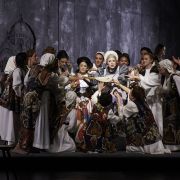
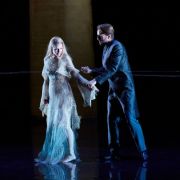
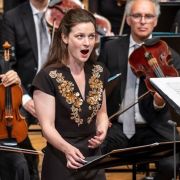
In Charpentier’s opera Les Arts florissants, an allegorical figure of Peace, Music and Poetry triumphs symbolically over Discord, with the final chorus celebrating a return to joy and the titular flourishing of the arts. Something of this spirit inhabits Paul Agnew, singer and co-director of Les Arts Florissants: a determined optimism and a joyful resolve.

Speaking over video call, Agnew describes a rich upcoming season for the ensemble, after a summer full of concerts held in William Christie’s topiaried French gardens and a series of informal events under the name “Purcell in the pub”. The aforementioned Charpentier opera opens the autumn season, paired with La descente d’Orphée aux enfers. Then comes a big Monteverdi programme of unaccompanied madrigals, which will take Les Arts Florissants on a sold-out tour in the USA, an ambitious series of Rameau and Mondonville motets, and a European tour of Handel’s opera about Richard the Lionheart, Riccardo Primo.
Both the Charpentier and Handel programmes serve as an opportunity to showcase the talents of Les Arts Florissants’ academy for young singers, Le Jardin des Voix. Raising the next generation of Baroque singers and preparing them to fly the nest has become one of the ensemble’s key missions. “Transmission is a big word,” says Agnew, “and that has become a very big part of our work. We’re not just a touring orchestra but we also think of ourselves now as in part an educational ensemble.”


In the autumn’s Handel concerts, between Riccardo Primo and Acis and Galatea, he estimates around 70% of the cast will be former students. “Le Jardin des Voix is now 24 years old, so it’s not as if all of them are very young singers, but they started with us… and we very much like to keep up with them throughout their careers”. Some of the alumni, like Marc Mauillon or Lea Desandre, may have acceded to higher realms of fame and fortune, but, Agnew smiles, “we still want to be associated with them and them with us. That’s part of the family ethos of Les Arts Florissants.”
Agnew details the ensemble’s other educational ventures: a series of masterclasses in Thiré, in liaison with the Juilliard performing arts school in New York, and a partnership with a Franco-Canadian Baroque foundation. “Lots of coaching, lots of encounters,” as Agnew puts it. “What I’m determined to do is lay a foundation for [the students] to have careers when they get to that point.”
It’s not the easiest time to be attempting to build a career as a classical musician. Agnew describes an oversaturated industry, shaken successively by the 2008 financial crash, by the Covid pandemic, by more recent budget cuts in France. “We’re in a very tricky time, but we’ve still got to get these young singers placed.” He speaks candidly about the economic realities facing early-career singers: “In some ways, it’s a good thing because they’re not as expensive as more established singers. And therefore, when you’re looking at budget cuts, people are looking for very talented, somewhat less expensive singers and players.”

Nevertheless, building a career “shouldn’t be the huge sacrifice where you live on Weetabix just because you’re a singer,” Agnew says. “You should be able to have a career. You should be able to buy a house and have a family.” Le Jardin des Voix wants to find those opportunities for its students, help them find their space on the scene. “We look for the best ones, and really push them and make sure that people know about them, and that they’re going to be able to take off and fly the nest.”
I ask how the academy has evolved over the last 20 years – if the people applying now are the same sort of people who were applying in 2002. “I think the standard has gone up,” Agnew replies. He describes a less strict division, culturally speaking, between baroque singers and “the other, ‘real’ singers”, alongside a shift away from “park and bark” delivery of the repertoire towards more nuanced contemporary performances. “We get a much, much larger portion of singers now who do not consider the Baroque to be a separate vocal practice.”
17th-century vocal music has much to offer young singers, in terms of sensitivity to text and phrase, tone and emotion. Agnew, who first started singing with Les Arts Florissants in 1992, has long been particularly interested in the transition between the Renaissance and the Baroque period. The nine Monteverdi madrigal books (one of them posthumous) created an initial draw, and Agnew’s first programmes as director of Les Arts Florissants followed Monteverdi’s life from Cremona to Mantua to Venice.


Part of what attracted him to this repertoire was the composer’s relationship to text, famously stated as “The text is the mistress of the music”, marking a historical shift in the relationship between melody and lyric. With poetry at the centre of the polyphony, moving away from the Renaissance focus on pure sonority, there is space for a more complex and interactive structure to emerge. “There’s a moment, about halfway through Monteverdi’s book five, where he introduces the continuo of the harpsichord. Once you get the harpsichord, you can have just one singer singing. And once you have one singer singing, then you can have one singer replying to another singer. And that’s really the birth of dramatic music.”
What was it that initially drew him to Monteverdi’s work? “All the secrets are there,” Agnew says with a smile. “If you’re going to interpret Bach or Handel, you can apply all of those rules which start at the beginning of the 17th century to everything you do afterwards. All the secrets are already there in Monteverdi.”
Agnew has been singing and programming this music since the 1980s, witnessing profound shifts in the industry along the way. “For one thing, we used to record everything. I remember in the ’80s and well into the ’90s I never had less than ten recordings waiting to come out – which is absurd.” The energy of the period, “this amazing rebirth of Baroque music”, has fallen off somewhat. In the last few years, Agnew recalls speaking to young American music students, and being taken aback by their negative perspectives. “They said: your generation and the generations before, surely you’ve done all the repertoire. There’s nothing left for us to do. And I just don’t believe in that at all.”
In Les Arts Florissants, there’s always space for a new interpretation, a new musical personality to emerge. “The dedicated people will come to the top,” Agnew says firmly. “And those – how to put this politely – less motivated, will not. And I think that's not a bad thing.” He emphasises the importance of hard graft and regular practice, even for more established or mature singers. “Nobody owes you a career. You need to keep working at it.”
So what does this mean for Les Arts Florissants, for Le Jardin des Voix, for Baroque music in 2026? “The more difficult the times,” Paul Agnew concludes, “the more people need this ephemeral art. And so it’s up to us to produce this art to a standard which fascinates them and entertains them.” Charpentier’s Peace, Music and Poetry would no doubt agree.
Les Arts Florissants perform Charpentier in Turin, Milan and Ambronay in September, and tour Monteverdi’s Madrigals through November.
See upcoming performances by Les Arts Florissants.
This article was sponsored by Les Arts Florissants.