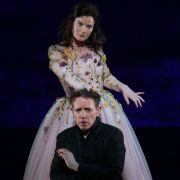
With this version of A Midsummer Night’s Dream, British creator Deborah Warner completes her own Benjamin Britten trilogy at the Teatro Real, which has given the Madrid house so much to celebrate. Her Peter Grimes and Billy Budd already grace the roster of local successes. In this production, Warner once again displays her undeniable theatrical talent and her affinity with Britten, although on this occasion, the musical side of things proved insufficient to raise this creation to the heights reached by its predecessors.

Warner’s theatrical language invokes the title at its most literal: darkness and the world of dreams, leaving to one side any possible interpretation of the subtext of Shakespeare’s play. It is an eminently aesthetic and visual spectacle. Her night is a friendly and hypnotic place, peopled with lovely, distorted elements of nature which, far from proving unsettling, provide endless touches of wonder, thus both continuing and contrasting with the darkness of her aforementioned stagings, respectively threatening or tortured. The direction of actors and dancers, studied right down to the smallest detail, also strives for overwhelming beauty. The organic choreography and a perfectly-judged impression of magical weightlessness, embodied above all in a duplicated Puck – reciting on the ground and flying through the air – are memorable. An outstanding proposal, dominated by evocative stagecraft, appealing to the senses rather than inviting reflection.

In musical terms, it was correct but not as convincing as it was theatrically, nor was it, casting one’s mind back, a match for her previous stagings. In the pit, Ivor Bolton, a Britten specialist, gave a carefully dissected rendering, unquestionably transparent and especially attentive to the timbres of the instruments, drawing fantastical scenes. There could have been greater narrative tension, though, especially for a story that requires it precisely because it is a comedy in order to avoid triviality.

This is an ensemble work, with no clear protagonist. The singers chosen came across as a well-integrated team – both in the positive aspects and in those that didn’t work so well. The whole cast lavished exquisite care on their diction and the value of each word, as well as the theatrical inflections of texts which persistently lay in the realms of recitative and arioso. Overall, the ensemble were somewhat lacking in lyricism, which Britten’s music does also ask for and benefit from, and their delivery might have been fuller.

Liv Redpath’s Tytania stood out among them all, exploiting the coloratura of her set pieces to the full. Clive Bayley’s theatrical nous and vocal intelligence as Bottom also deserves a mention. Among the Athenian lovers, Jacques Imbrailo’s Demetrius best displayed the connection between musicality and theatre. If there were one singer who might have shown more musical intention, that would have been Iestyn Davies as Oberon – charismatic at some points, vocally reserved at others.

The teenage dancers and children’s choir, the Pequeños Cantores de la ORCAM, added a layer of innocent mischief which rounded off a theatrically unimpeachable show, thus bringing to a close a memorable trilogy which crowns Deborah Warner and her team as the sovereigns of Britten nights at the Teatro Real in Madrid.
Translated from Spanish by Aaron Vincent.