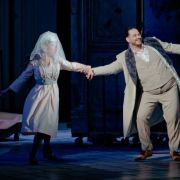

Romania’s countryside is full of old manors that have seen better days. The class comedy and conflict in Le nozze di Figaro present challenges to contemporary adaptation, but Sir David Pountney’s staging strikes home at the Bucharest National Opera, probably more plausibly so than when it was first mounted in Tel Aviv by Israeli Opera in 2022.

Ingeniously mobile sets by Leslie Travers deconstruct the Count’s pile – recently inherited, since this is a youthful cast of central protagonists – while generically modern costumes by Ula Shevtsov do just enough to emphasise who’s in charge, or who believes they should be. Not only the Count himself, spying on Figaro and Susanna as they bicker over sleeping arrangements, but also Sidonia Nica’s frayed Marcellina, rifling through the maid’s underwear and then stubbing out her cigarette in it. Design, drama and singing all combine to illustrate a sibling relationship between Figaro and the more enigmatic world of Così fan tutte. Young and careless people do horrible things to one another, and their elders are certainly not their betters.

Our Figaro in Bucharest was Iustinian Zetea, one of several company stalwarts caught on this revival in their vocal prime. Supporting the bluff charm of his “Se vuol ballare” in Act 1 was a dark-stained and oaky strength that came into its own with the barely suppressed menace of “Aprite un po' quegli occhi”. His sparring with the Count of Sebastian Balaj presented a study in baritonal contrasts, with Balaj stronger at stressing impotent rage than entitled authority in “Hai già vinta la causa!”
While Paula Iancic’s Countess was initially caught banishing her sorrows with ice-cream in bed, she bestowed true nobility on “Porgi amor” in her role debut, languorously paced but affectingly sustained. Here too was a pleasing contrast with the sharper and more assertive edge of Susanna as sung by Anna Stănescu, who again justified some indulgent tempi set in the pit by Vlad Conta with a luscious “Deh, vieni, non tardar”.

As Cherubino, Martiniana Antonie came close to stealing the show from her colleagues, confirming the excellent impression left by her Rosina at this year’s Bucharest Opera Festival. In “Voi che sapete” she built the sexual tension of the scene without dropping a stitch, while “Non so più” majored on a sassy teenage self-possession that elegantly skewered the assertions of status from everyone around her. I would gladly see her again, but so I would the delicious cameos from Ioan Coca as the stuttering Don Curzio, and Andreea Guriță Novac as a classy Barbarina.

Legato never comes as an optional extra in the Romanian vocal tradition, and it was good to hear the Bucharest company back on home ground after the experimental German of the previous night’s Tannhäuser. And yet the meta-opera trappings of Pountney’s staging also pulled the singers out of a stand-and-deliver comfort zone. The finale brings a curt pardon from the Countess, then a flurry of action. Everyone stands ready to move on, leaving the Count caught frozen in the centre (another illuminating parallel, this time with Don Giovanni), and it becomes clear that this folle journée has changed the lives of all concerned for ever.