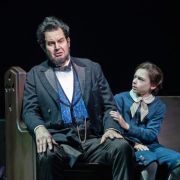

Following various nationwide festivities – ranging from historical reenactments to Formula One races – celebrating the 250th anniversary of the United States, the Metropolitan Opera is presenting an operatic tribute: Missy Mazzoli’s Lincoln in the Bardo, the first opera composed by a woman to be commissioned and premiered by the company. The two-act work is based on George Saunders’ 2017 Booker Prize-winning novel about Abraham Lincoln’s devastating grief following the death of his 11-year-old son, Willie.

Set to a libretto by Mazzoli’s frequent collaborator, Royce Varek, the otherworldly tale blends historical fact with supernatural fiction and takes place in February 1862, ten months after the American Civil War broke out. Set in the supernatural world of the “bardo” – a transitional state of existence between this life and the next – the story centers on the President’s difficulty in leading the relatively young republic through fraternal conflict while coping with his son’s premature demise, as well as Willie’s own struggle to move on to the next world despite the encouragement of his fellow spirits. These ghosts are trapped because they deny that they are dead, preferring to think of themselves as enduring a temporary “malady” and referring to their coffins as “sick boxes” while they wait for a doctor’s cure.

Returning to the Met two years after her success with John Adams’ El Niño, Lileana Blain-Cruz has created a genre-bending, visually spectacular, surprisingly joyful production. Adam Rigg’s flexible, highly efficient single set design, awash in the lava lamp hues of Yi Zhao and Stacey Derosier’s lighting, presents an eerie, forest-like environment filled with trees and overgrown grass. Painted in various shades of gray, violet and green, the spectral setting blends seamlessly with Montana Levi Blanco’s brilliantly inventive costumes and the haunting movements of the ghostly inhabitants. Equally well integrated into the set design is the puppetry, one of the most striking elements of the entire production. Instead of depicting individual characters, James Ortiz’s giant puppets represent extensions of the souls and inner psyches of the bardo’s inhabitants.

Mazzoli’s eclectic and atmospheric score is a fascinating, constantly shifting blend of traditional orchestral writing and unconventional vocal and instrumental effects, including a huge chorus humming into kazoos. There are numerous explosive musical passages, especially the “matterlightblooming” moments sounded when individual souls in the bardo finally accept death and move on to the next phase of their existence.

The mostly splendid cast assembled for this production is led by Peter Mattei, who delivered a heart-wrenching portrayal of Lincoln, perfectly conveying his character’s personal grief layered against the political trauma of the Civil War. His Act 2 “Dear Little Chap”, sung as he cradles the body of Willie, was a highpoint. Another stand-out performance was Christine Goerke’s scene-stealing portrayal of the Reverend, one of the three ghosts guiding Willie on his journey toward acceptance. The soprano’s most impressive moment – dramatically and vocally – was in Act 2 when her character reveals how he is different from the other inhabitants of the bardo in that he has had a glimpse of the final judgment and knows that he is dead.
By contrast, countertenor Anthony Roth Costanzo’s overly nasalized, camp depiction of 14-year-old bardo-dweller Miss Elise Traynor, who died before achieving her dream of romance and motherhood, was less successful.

As Thomas Havens, Joshua Blue used his heroic, self-assured tenor to offer a particularly poignant portrayal of a former slave. As the two other souls guiding Willie, bass-baritone Ryan McKinny as Vollman and tenor Jonah Hoskins as Bevins provided some of the evening’s most mirthful moments. In the demanding role of 11-year-old Willie, Everett Sobers made an impressive Met debut, his amplified but appropriately pure and ethereal-sounding treble wonderfully juxtaposed with Lincoln’s stately, tenderly voiced music.
Under Yannick Nézet-Séguin’s ever-attentive baton, the Met Orchestra sounded energetic and polished throughout the night, as they navigated Mazzoli’s mercurial and blazingly colorful score.