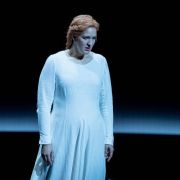
As a quintessential myth of medieval literature, Tristan und Isolde defines itself as a legend that captures the incorporeal rather than the earthly. The mythical aspect concerns the utopian nature of the relationship between its protagonists. It is not a love story; it goes beyond that. The human boundary is crossed, transfigured. Reason is incapable of establishing a definition or a comparison, not even a justification that conceives of love as Tristan and Isolde contemplate it. This is the spirit of Wagner, whose music has guided everyone through these realms since its creation. As a seminal work in the operatic repertoire, this Tristan und Isolde was called upon to be a milestone in the chronology of the city's theatre, with the birth of a new Isolde – Lise Davidsen – led by the baton of Susanna Mälkki, who brought the house down with her Il Trittico a few years ago.

To the surprise of many, the expectations that this production would be a triumph waned as the three totemic acts unfolded. Bárbara Lluch approaches the Wagnerian dimension with an almost exasperating modesty; she gives us a self-effacing production, presented as minimalist (a concept that is beginning to be misinterpreted), stripped of all elements, empty and bare, in what appears to be the irrefutable notion that Wagnerian purity is unattainable. In a way, it is, but even with that justification, this can be considered a staging approach that reaffirms this idea. From start to finish, the production seems to be shouting “sorry for disturbing you”. Lluch has eliminated so much that she has been left with nothing; her intention (we would like to think) to cede the stage to the music as the protagonist of the drama has ended up being a literal reflection. Such respect becomes a cold detachment in which the characters are reduced to a disoriented loneliness on stage, on giant, mobile platforms without context. The idea of a metaphysical atmosphere hovers over the production, with abstract lighting (created by Urs Schönebaum) making the protagonists the only ones present, without a meaningful dramaturgical interpretation, sheltered by a transcendental light that intervenes as a third voice in the couple's emotionality, blinding them with the best of loves and, in passing, blinding the audience as well. This exercise, which at best could be read in a synaesthetic key, has economised so much on resources that it fails to have any meaning. Alone, out of place and hampered by a lack of scenic coherence, the exceptional nature of the work was undermined by the poor performance of the artistic team.

In terms of the music, the radiance and ultimate hope were left in the hands of Susanna Mälkki, who responded to the dramatic-musical poem with a direction focused on poetic amplification and centred on translating the immensity of sound in the score. The Liceu orchestra pit marked a predominance of harmonic conjunctions, tensions, dissonances and the diversity of its orchestral palette: elements highlighted in this reading, where the string and brass sections led a display of control, complexity, endurance and musical flexibility. Mälkki's reading maintained dramatic pulse, accommodating the details between score and singers; this Wagnerian challenge confirms the orchestra's structural knowledge, which requires the unification of the story, music and nature of the opera itself. Without a doubt, her conducting found the balance between density and complexity, thus safeguarding the production. Lise Davidsen made her debut in the role of Isolde with the best of virtues. With a vocal technique that is fully reaffirmed and mature for her youth, she maintained the emotional intensity and conveyed the seriousness of a character, tackling prolonged climaxes without losing the timbral beauty of her phrasing. She was accompanied by Clay Hilley as Tristan, a textbook performer with more than a dozen performances of the role under his belt. He knew how to pace himself, going from less to more, to culminate in a perfect third act, mastering the expressiveness of the character and giving him tenacity. Ekaterina Gubanova as Brangäne and Brindley Sherratt as King Marke were very successful counterpoints to the protagonists, bringing a personal brilliance to their characters.

Among the audience, the division was clear, with such antagonistic responses, between cheers for the musical part and condemnation of the artistic direction, that there was no shortage of ovations at the premiere, mainly for the work of the Davidsen-Hilley-Mälkki trio. The vocal and instrumental level was excellent, with personal nuances that did not detract from the Wagnerian reverberation to which the Liceu has accustomed its audience. An audience that returned home that night with flashes in their eyes: let us imagine that these were to the metaphysical flashes of love.
Translated from Spanish by David Karlin.