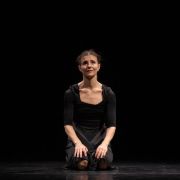
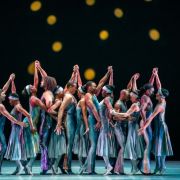
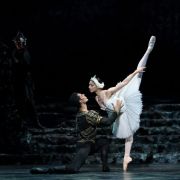
Jamiel Devernay-Laurence’s Ballet Nights performances never disappoint. It’s the introduction of dancers new to the UK, the fine balance between music and dance, and the rich diversity of offerings on the programme. Ballet Nights 011 – Convergence at Cadogan Hall encapsulated all that is good about the venture.

While it may occasionally need some tweaking, the blueprint for performances seems to appeal to a wide audience who seek variety. Certainly that was the buzz that circulated all the way down to the Tube platform after the show.
A delightful rendition of Beethoven’s C major “Razumovsky” String Quartet, delivered by Quartet Concrète with fleet precision, set the mood for what turned out to be another Ballet Nights winner. One of the ‘firsts’ of the programme was the London debut of two dancers from Pittsburgh Ballet Theatre, Hannah Carter and Lucius Kirst. Choosing to open the dance part of the evening with the first movement from the late Ben Stevenson’s Three Preludes, their’s was an exemplary interpretation. I am always moved by the way Stevenson has expressed the music (Rachmaninov) through lyrical movement, echoing the crescendos with sweeping arms and deep arabesques. Carter, in particular, was well suited to this, showing beautiful lines and footwork.


The couple also closed the evening with what was described as a ‘sneak peek’ at what will eventually become a full-length Nutcracker by Trey McIntyre for Pittsburgh Ballet Theatre. A duet danced to the final pas de deux, I confess to finding it hard to un-see the usual choreography and couldn’t conjure up the grandeur of the Sugar Plum and her Cavalier. There were some highly original lifts which were deftly executed but perhaps the struggle to make it work was for the simple reason that it was taken out of context.
In between the Pittsburgh duo we were treated to a solo, Frame, created and danced by Germain Zambi, a French dancer who has found great success in fusing Krump with contemporary dance. For those unacquainted with Krump, it’s a fast, energetic, expressive style of street dance. I liked what I saw, but had the feeling that this brief introduction to Zambi’s work was just the tip of the iceberg. It would be interesting to see him again.

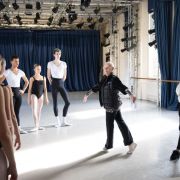
The second year students from English National Ballet School and Lily Moran who is currently part of the ENBS Graduate Artists Programme danced a piece choreographed by their director, Lynne Charles, last year for the Next Generation Festival at the Linbury. Études on a Theme of Satie was a showcase for polished classwork with a bit of extra thrown in. Charles has created a specific programme for strengthening pointe work, 4Pointe, and if this performance was anything to go by, the footwork was impeccable. So good to see the students really using their metatarsals. The men were excellent too. Moran is a strong dancer who is surely ready for a professional career and while she seemed removed from the rest of the cast by way of the choreography, she proved herself very capable.
A highlight of the first half was Floating Flowers brought to us by B.Dance Company, Taiwan. Flown in late the previous night, rehearsed during the day and ready to be flown out again the following morning, if they felt tired, it did not show. Choreographed by Po-Cheng Tsai and performed by Shu-Han Yeh and Hsin-Chieh Chou, it was a quirky, very entertaining piece of clever choreography and danced with supreme energy and focus.


The first half concluded with exquisite ballerina, Alina Cojocaru and partner Denys Cherevychko dancing Balanchine’s pas de deux from Diamonds. She is eminently watchable. What came across was a complete lack of rapport. Perhaps they had not had much time to rehearse but I thought Cherevychko had a distinct problem with finding her centre of balance. She was constantly back on her supporting leg and literally ‘fighting’ to stay centred on her pointe shoes. He redeemed himself in Ben Van Cauwenburgh’s Les Bourgeois.

Significant in the second half was an all too short pas de deux from Peter Darrell’s Chéri. Danced by BRB’s Samara Downs and Ixan Llorca Ferrer, it is a measure of Darrell’s genius that we can be so touched by a few minutes of his choreography. Darrell died in 1987 and there will be plenty of recognition of his work next year and also in the year reflecting his birth, 1929.

‘Best in show’ was ENB’s Rentaro Nakaaki’s Bloom, Then Fade. The rising choreographer and dancer has made something very special. Narratively clear – about aging, love and loss, it couldn’t have been more eloquently portrayed than by Fabian Reimair, Martinho Santos and Swanice Luong. Reimair lives and breathes what he dances with truly exceptional artistry. I hope this is expanded and goes into the rep at ENB.