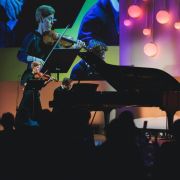
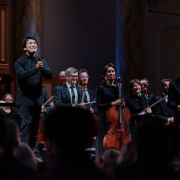
Franz Schubert’s Winterreise has inspired countless reinterpretations, but few take as distinctive an approach as Spring Snow: A Kabuki Winterreise, presented this weekend at Wigmore Hall. Combining twelve of the 24 songs about a wanderer beset with grief and elements of Yasuna, a Japanese dance drama about a man driven towards madness by grief, the production explores the emotional territory shared by two very different artistic traditions. The musical results are compelling, even if the theatrical staging doesn’t quite pay dividends.

Acclaimed mezzo-soprano Fleur Barron, one of the production’s co-creators alongside dancer Suleiman Suleiman, was its greatest asset. Her singing combined vocal warmth with clarity of pitch and a finely judged sensitivity to Schubert’s shifting emotional landscape. She found an admirable balance between expressive intensity and restraint, allowing the melancholy in the lyrics to emerge without tipping into sentimentality. The opening was particularly effective when we heard Barron’s singing before we saw her. Entering from the back of the Hall, she sang while walking slowly down the aisle, an almost ghostly presence. This was echoed at the end, as she returned to leave the hall using the same route.


The musical partnership was equally assured. The piano writing in Winterreise is integral to the traveller’s inner world, its restless rhythms and recurring motifs giving psychological weight to the poetry. The restless rhythms and recurring motifs are integral to the wanderer’s inner world. Jong Sun Woo’s playing and Hibiki Ichikawa’s shamisen brought out these complexities. The shamisen’s distinctive, multi-timbral sounds provided a fascinating counterpoint to Schubert’s familiar musical language. This interplay was most effective when the instruments retained their individual character, complementing rather than attempting to assimilate their respective idioms. It was a pity that Woo was positioned with her back to the audience; greater visibility of her gestures and physical engagement with the music would have enriched the performance.
The staging made an intriguing structural choice, opening with Der Leiermann, Schubert’s final song, before returning to it at the close in a solo piano version. This framing foregrounded the wanderer’s loneliness from the outset, with the intervening sequences tracing the psychological terrain of isolation and despair.

Each group of songs was prefaced by a kabuki-inspired scene danced by Suleiman, an actor and theatre-maker whose long-standing interest in Japanese culture led him to found London’s Kabuki Club. His stylised movements conveyed anguish and yearning, but the choreography raised a question about the depth of the encounter with kabuki itself, an extraordinarily codified theatrical form, in which gesture and posture carry meaning through a highly developed physical vocabulary. Suleiman’s interpretation felt more individually devised than governed by the formal precision of traditional kabuki. The result was an evocative contemporary response to the form, rather than an encounter that fully communicated its distinctive theatrical discipline.


Even so, Spring Snow is an ambitious and emotive production. Purists may find the theatrical language less convincing than the music, but the meeting of these traditions remained thought-provoking and deeply engaging. This was a haunting performance that will echo through time.