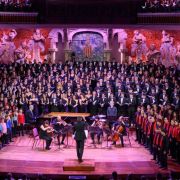
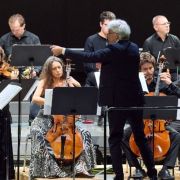
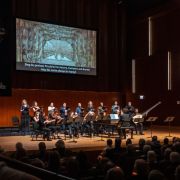
Given news both recent and evergreen, economics might seem like the last subject classical musicians would be interested in taking up, but composer David Lang is known for bold concepts. The world premiere of his The wealth of nations, conducted by Gustavo Dudamel in the world’s economic capital, could not be more replete with challenging context.

A joint commission of the New York Philharmonic and the Aspen Music Festival and School, Lang attempts to give Adam Smith’s work the Messiah treatment, but not without qualification, critique and voices from beyond the famous treatise from which Lang’s piece takes its name. Representing a decade of labor, amounting to more than 900 pages and ultimately serving as a cornerstone in the discipline of modern political economy, Smith’s magnum opus, while seeking to be scientific in its evaluations, is certainly religious in its scope. It may lack divine inspiration, but is a peer of the Bible in its impact on the formation of the consciousness and ethos of the early American project.


Musically, what stands out most about Lang’s Nations is a strong theme rendered between bright strings and energetic percussion reflective of the pure spirit of industriousness, in contrast to the sundry negative consequences often associated with it, both in Lang’s lyric choices and in society at large. One of the more interesting and memorable sequences comes in the movement from the instrumental “pifa” section to the men’s choir’s “a confession”. A luscious, extended engagement split between three trombones gives voice to the “invisible hand” and its unknowable yet apparently, to Smith, benevolent plan before its first verbal mention in the work.

Davóne Tines displayed an adept and willing bass-baritone, but seemingly lacked places in the score to exhibit his vocal strength and range of skill. One of the few passages that realized spiritual affect – thanks to his efforts – was a section titled “the woolen coat”, a meditation lifted directly from Smith in which he muses on the astronomical amount of human labor that goes into something so simple as keeping clothes on our backs.
Mezzo-soprano Fleur Barron, in her NYPhil debut, responded to mixed-quality vocal writing with a mixed-quality performance. While there were brief phrases in which her tone was delightfully rich, even suggestive of her possibly being a rare contralto, most of her performance lacked color and was often breathless.
The most successful vocal writing was reserved for the choir, who performed fabulously with the exception of a few soloist call-outs that were less successfully executed in “statement to the court”, utilizing the words of Eugene Debs from his sedition trial. An adjustment on a previous piece commissioned by The Crossing, the musical maturity of the piece is considerably stronger than the rest of Nations, but seems to knock the arc of both philosophical and musical arguments somewhat off course.


Dudamel had little issue with managing the sound from the stage, with the exception of a moment in the beginning when the orchestra and choir were fighting each other to be heard. Later in the work, there was a similar section, but Dudamel managed the dynamics well enough that it was clear that this competition was intentional.
Whether or not one buys into Smith’s arguments about money – or Lang’s – the laughter of audience members responding to some lyric choices suggests that the full piece is more likely to wind up on an Economics 101 syllabus as a prompt for extra credit than in music halls beyond its commission. Nonetheless, there are musically valuable sections that could surely be excerpted and make for perfectly enjoyable listening.