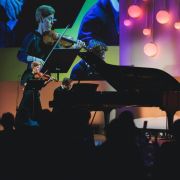
The UK premiere of New York composer Julia Wolfe’s latest climate-change oratorio unEarth was certainly enormous, and packed with talent. Not only did we have the BBC Symphony Orchestra out in full force with the BBC Singers’ male choir on the stage of the Barbican, we also saw the National Youth Voices, Finchley Children’s Music Group, Danish soprano Else Torp and conductor Martyn Brabbins come together for this plea for action against the climate emergency.

And indeed, Wolfe’s calibre and the quality of the musicians was evident: some moments in the three-movement piece rose to a powerfully gargantuan wall of sound. At times the orchestra reached a frenetic urgency reflective of the climate crisis, and some of the percussion sections were militaristic and exciting. The choirs were disciplined, showing good control of dynamics and precise diction under Brabbins’ accurate conducting. Torp's clear and melodious soprano glided effortlessly and resonantly over the swell of music beneath her.


The problem, however, lies in the message of the oratorio. At a time when various composers have issued focused calls to action – such as Ludovico Einaudi’s 2016 work Elegy for the Arctic, or Elena Kats-Chernin’s 2011 Symphonia Eluvium – there seems to be value in pieces having a real message.

Unfortunately, the message in unEarth felt garbled and at times a little infantilising. The three alliterative movements – Flood, Forest and Fix It – each took a theme, and projection designer Lucy Mackinnon and lighting designer Ben Stanton had placed a huge disc above the stage, showing images in tandem with each.
In Flood, we heard rolling wave sounds and saw turbulent waters, while the children’s chorus sang of a monster coming to devour the earth – while gesturing “monster” with their hands. The takeaway was easy: climate change causes environmental devastation. In Forest, the men’s chorus chanted various words for “tree” in different languages in a move we’re told was to replicate the interdependence of the woods, and sounded like a fervent vocal exercise. There were rain sounds, and images of toadstools and ferns and woodland scapes. At one point the performers were bathed in green light.
Meanwhile there were repeated glissandi, with Torp eventually singing the compelling lines of Emily Dickinson’s Who robbed the woods?. These were all moments that individually might have been quite powerful, but cumulatively felt a bit much – and giving not much more than the message of Hollywood blockbuster The Day After Tomorrow, which came out 22 years ago.

The final movement – Fix It – saw the men singing of “deforestation” and “fragmentation”, at times fragmentedly. There were more distorting vocal glissandi, before the children’s chorus stood up and raised their hands to sing climate activist slogans such as “there’s no planet B”.


It’s difficult, in all this messaging, to take away a message. If the message is that we are facing a dire climate emergency, that is a message that we have been given for at least two decades. If the message is that the world is letting down its children, that is again something that has been hammered home, at least to the audience attending one of the Fragile Earth performances at the Barbican Centre. At any rate, the use of projected footage of smiling children in sunny glades as the children’s chorus sings about riding bikes and Meatless Mondays feels at best twee and at worst manipulative.
As the world continues hurtling through climate crises, it feels as though artists have a calling to find new things to say, in order to engage an increasingly aware audience.

In a prelude to the oratorio, Brabbins led the BBC Symphony Orchestra in a luscious, measured rendition of Aaron Copland’s Appalachian Spring. Tied to unEarth by its appreciation – and its own idealisation – of the natural world, Copland’s work showed a mastery of lyricism, bringing a fresh breath of life almost 80 years after it was first performed. Its call to adore our world with joy and humility in the face of human war had its own clear message: ‘tis a gift to be simple.