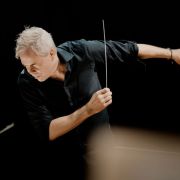
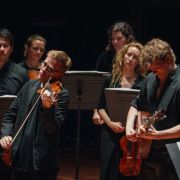
The nearest I’ve come to being immersed in Mahler was a 10km Alpine hike in the Voralberg, serenaded by the clanking of cowbells, a scene that could have come straight out of the Sixth Symphony. That was until this event at Smith Square Hall, directed by Tom Morris and dubbed “The Mahler Experiment”, which placed the audience in the thick of the action during a semi-staged performance of the First Symphony. Resident ensemble Sinfonia Smith Square played Yoon Jae Lee’s lean orchestral reduction, conducted by Stephanie Childress.

Usually it is verboten for Bachtrack’s writers to comment on audience behaviour – and quite rightly too, as we’re there to review the performances rather than report on standing ovations or castigate clapping between movements – but here the audience was very much part of the performance, responding to the licence to roam that Morris gave us during a rambling introduction. To begin with, that response was terribly British: cautious, polite, not wanting to block anyone else’s view… but gradually, led by the “facilitators” on hand, more people left their seats and began to wander, at first around the fringes of the ensemble until a few brave souls invaded the sacred space between conductor and players.


Mostly standing, the musicians themselves were also on the move, peripatetic performers very much in the style of Aurora Orchestra’s presentations but without the gimmick of playing from memory. The symphony began in near darkness, strings enveloping the audience in their hazy, seven-octave drone. Woodwinds, clustered in the centre, chirruped as dawn gradually broke, trumpets in the balcony announcing their reveille from the “very far distance” that Mahler stipulates in his score. The strings then filed past to take up their places, the Sinfonia creating a more-or-less traditional layout facing the main bank of seating, albeit with woodwinds on the extreme right of the aural picture.

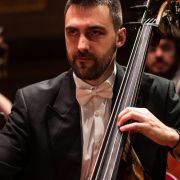
All-change for the orchestra during the inner movements, where I suddenly found myself sitting right over the shoulder of the double basses – great for the spotlit Frère Jacques solo in the third – with Childress at the centre of the web, gradually joined by members of the audience, experiencing the cross-play between sections. One lady swayed in time to the Ländler as more people took to the floor. The clarinets relished their raucous klezmer interruptions; this was a performance that was strong on bold characterisation, even if it fell a little short on Viennese charm, some string phrases missing those teasing ‘lifts’.


Balances were naturally entirely different to what you’d experience from a traditional concert seating arrangement, especially if you were on the move too. The ebullient final movement, announced by a cheesy lightning flash projection and a red glow, found me next to the timpani for the pulsating coda – the earth moved! – while others were aurally knocked flat by the horns. It was a performance that threatened to derail at any moment, but never actually did – the sense of jeopardy was all part of the thrill. This was a brave attempt – an experiment that paid off handsomely – at doing something different, immersing in the music, living Mahler’s score from the inside out.