Perth based group Australian Baroque, in collaboration with West Australian Opera, have come up with a brilliantly entertaining evening garnished with first class musical values. The two main cantata events were supported by some little heard (in these parts) orchestral additions, with never a dull moment.

The stage was set up, curtains drawn, with a harpsichord, small tables and decorative bird cages, as well as a case labelled “Marjorie’s Menagerie”. Before the music began, the audience was welcomed by viola player Christian Read and Australian Baroque founder, artistic director and leader Helen Kruger, laying out the contours and zoological theme of the program. Everyone involved in this first half was in some way bedecked with feathers.
The first item was Alessandro Poglietti’s Aria bizzara del rossignolo (from the Suite in D major: Rossignolo) for solo harpsichord played by James Huntingford. This eccentric piece is, not surprisingly, characterised by much tweeting and trilling, with a more familiar Scarlatti-type middle section, before an avian conclusion, all played with a light touch and a knowing smile. A veritable menagerie followed, in Biber’s Sonata Representativa in A major, in which Huntingford was joined by Kruger, cellist Krista Low and double bass player Jacqueline Dossor. Each species was announced by Read, starting with the obligatory nightingale, followed by cuckoo, frog (bringing to mind Telemann’s Concerto for Frogs), chickens, an especially sympathetic cat (given what was to follow) and so forth, all rendered on the violin, a somewhat extraneous musketeers march and finally a “gracious allemande” as a thank you to the audience, who were enjoying it all immensely.


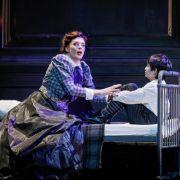
Then followed Telemann’s Trauer-musik einded kunsterfahrenen Canarienvogels, a “tragic-comic cantata” from 1737. The ensemble was now enlarged with a second violin (Hannah Herriman), viola and flute, and as they struck up, Marjorie of the menagerie now appeared, in a purple turban with yellow plumes, clutching her dead feathered friend. She was embodied by German-New Zealand mezzo soprano Brigitte Heuser, who was responsible for the clever English translation, rendered for an Australian audience. In this version, not only did she revile the culprit, but actively sought its demise, then promised to “turn my pain into environmental gain” by advocating a cat containment policy, currently a hot button topic in Perth and other parts of Australia, and concluding that she had become a “crazy cat lady”. It should be noted that she sang with excellent diction, as well as smooth rich tone.
After the interval, the bird cages were removed, to be replaced by a small table with coffee making apparatus. The ensemble returned wearing 18th century-ish wigs, the men in frock coats, Kruger with a coffee cup in her wig. The initial item, Telemann’s Don Quixote Suite), was introduced by tenor Euan MacMillan who also introduced each movement. The opening was especially lovely, with interplay between Kruger’s violin and Andy Skinner’s caressing touch on the flute, and the whole thing was quite captivating, up to the lolloping donkey and the last uptempo section with Kruger’s virtuosic violin playing.
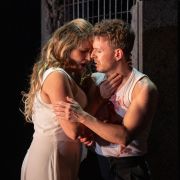
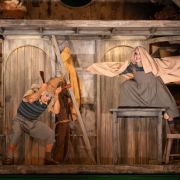
Finally, Bach’s wonderful secular “Coffee Cantata”, Schweigt stille, plaudert nicht (BWV 211), from a production which originated in London under the aegis of Kruger and Dossor, stage design by Elizabeth Gadsby. This featured another clever translation, now with an Australian twist (we do love our coffee). Our trio of singers comprised authoritative baritone Brett Peart as Herr Schlendrian, here called Shlump, in purple coat with an elaborate jabot; elegant tenor MacMillan as the narrator, and the exemplary soprano Prudence Sanders in a gorgeous yellow gown with a front panel of pink roses. She sang as gorgeously as always, with crystalline purity, flexibility and pinpoint accuracy, and everyone enunciated with perfect clarity. The orchestra were attentive to every nuance of the score, with Kruger’s violin and Skinner’s flute again outstanding.