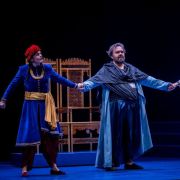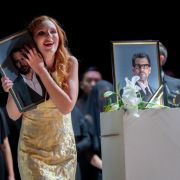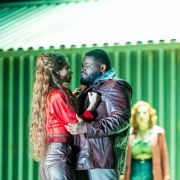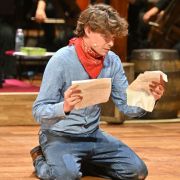


Whether in politics, in business or in the family, we all know that one person who ranks themself and their needs above the good of the collective. They will insist upon the best office, or the biggest slice of cake; they will foment rebellion against their party leader or wield the proverbial knife on a rival just to shimmy another inch up Disraeli's greasy pole. Theatre relies as much on company spirit as it does on individual stars, and Donizetti's Le convenienze ed inconvenienze teatrali shows, with hilarious effect, what happens when every member of the company is pulling in different directions. Silvia Paoli's new production is fantastic third and final opera for this year's offerings at the Donizetti Opera Festival in Bergamo.

In Le convenienze, a shambolic theatre company is attempting to stage a new opera; the conductor-composer Biscroma Strappaviscere is frantically trying to drill his troops, but the prima donna Daria is infuriating the rest of the cast. Luigia, the second lady, is amiable enough, but when her mother, the fearsome Mamma Agata, gets involved, mayhem ensues and eventually the company abandons the production indebted and skips town.


As with all metatheatre, it's full of inside gags and shows off Donizetti at his most inventive and mirthful – flicking between the classical period, riffing on Rossini and inserting his own genius so that the piece, in addition to being screamingly funny, is a little chocolate box of delights. Paoli's production, updated to a 1950s setting, is absolutely true to this spirit and takes it further, referencing great 20th-century sopranos and inserting extracts from Grazie Dei For and Nel blu, dipinto di blu – I'm fairly sure I also caught some Wagner!

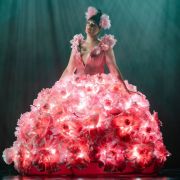
No expense seems to have been spared in Eleanora De Leo's set: the first half is a large bar, with the chorus cheerfully playing card games and a stoic barman proffering constant drinks as rehearsals deteriorate. For the second half, we shift to a hall for a dress rehearsal, with an endless array of changing backdrops and superb costumes by Ilaria Ariemme; one of the gags for this production-within-a-production is the constant juxtaposition of quality – exquisite scenery – with absurd amateurism: hobby horse, dodgy helmets etc. Above all, the two things that Paoli gets right here are precision in comic timing and superb direction. Her Personenregie is impeccable: everything is organic, everything in motion – not a single singer is left standing aimlessly.

As in Donizetti's day, the production's success rests on the role of Mamma Agata, a rare occasion when a male singer takes on a female role. Bass-baritone Paolo Bordogna gave a barnstorming performance, tearing up the stage in a variety of costumes ranging from tweed suit to Swiss milkmaid to an eye-catching mermaid's outfit. His timing, his mannerisms and his total commitment to the role made this a performance not easily forgotten. Vocally, the role demands a great deal and while Bordogna kept up with the patter and was able to belt out the money notes, there were occasions when the colour and volume seemed to drop. This did not detract from a masterful buffa display.


Bordogna's interactions with the Daria of Elene Gvritishvili, particularly the magnificent duet "Ch'io canti un duetto?" were among the production's highlights. Gvritishvili has a creamy soprano with pearly top notes and integrated registers. She played the diva with flair, ramping up the strops while also giving that touch of humanity that emerges when no-one is looking – such as the guilty pleasure of a sandwich. Filip Filipović gave us an angsty Guglielmo, a touch of gothic incel to him, but with a burning soul beneath his precious black coat, all sung with an ardent tenor with gleaming top.
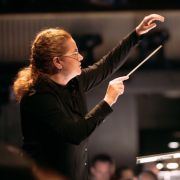
Giovanni Accardi's resonant baritone had a pleasing edge, suited to the exasperated Biscroma, while Veronica Prando impressed with Luigia's rather parenthetical lines; she has a lovely silvery soprano that rather glimmers, and a facility for cartwheels. Giacomo Nanni captured the uxorious Procolo to a tea in a delightfully fraught performance, but at times was a tad muted; his isn't the largest of baritones and he struggled to make himself heard above the rest of the ensemble. The Coro dell'Accademia Teatro alla Scala threw themselves into the comedy with some fine singing, the ladies in particular giving a merry performance. In the pit, Alberto Zanardi drove the Orchestra Donizetti Opera in a velvety, thrusting reading of the score that at times slightly overwhelmed his singers.
This was one of those performances that blended high quality music making with the best of comic direction; I would happily have seen this again on the same day. A fine conclusion to the festival's offerings.
Dominic’s press trip was funded by the Fondazione Donizetti