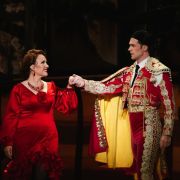
Olga Kulchynska made Tatyana the emotional center of Santa Fe Opera’s Eugene Onegin. She established Tatyana’s vulnerability from her first appearance, singing with a secure, expressive soprano and finely responsive phrasing. In the Letter Scene, her initial tentativeness gradually opened into growing confidence and daring, making Onegin’s subsequent rejection all the more crushing.

Alessandro Talevi’s 2021 production was hampered by pandemic constraints but has been revived this season with the chorus fully integrated onstage. Talevi surrounds Tchaikovsky’s “lyric scenes” with a world in which 19th century Russian society is permeated by something older and more elemental: a pagan, folkloric realm of forests, animals and dreams. Not every element coheres, but several of the stage images lodge in the memory.
Gary McCann, who designed the set and costumes, makes the Larins’ grand country house strangely porous to the natural world. White-barked birches rise through its austere, somewhat faded interior, as though the forest has taken root inside the drawing room, while the space far upstage opens onto an autumnal landscape populated by figures adorned with antlers, animal-like masks, flowers and vegetation. Tatyana seems peculiarly receptive to this older world. Meridian Prall’s kindly, knowing Filippyevna provides a grounding counterpresence to Tatyana’s more imaginative realm.


Talevi also sharpens Tchaikovsky’s tension between private feeling and social ritual. During Onegin’s rejection, he seats Tatyana before him like a chastened schoolgirl for the “lecture” referred to in the libretto, while a dancing lesson continues around them. His lesson in restraint becomes all the more humiliating amid this spectacle of social instruction. Dream and reality subsequently bleed into one another: after the rejection, Tatyana watches Onegin approach through the woods before they embrace in a fantasy of the happiness denied her.

Later, the same room becomes the setting for the duel, with one of its invading birches felled across the stage. For Prince Gremin’s palace, gilded candelabra and Rick Fisher’s warmer, brighter lighting transform the same architecture into a glittering ceremonial space. At the balls, Tchaikovsky’s formal dances give way to unruly movement in Athol Farmer’s frenzied choreography, at times suggesting an almost orgiastic party. With his ceremonious fussiness, Ya-Chung Huang’s Monsieur Triquet provided deft comic relief.
Most compelling was the authority Kulchynska brought to the final confrontation with Onegin. As Tatyana confessed that she still loved him, lightning flashed beyond the open-air theatre, uncannily accompanying the admission that she had come so close to happiness. Kulchynska’s bearing made both the temptation and her refusal painfully convincing.
Mattia Olivieri had the vocal amplitude for Onegin and, with his tall, lean figure, an imposing stage presence well suited to the character. Dramatically, however, the characterization was less persuasive. Early on, he never quite projected the jaded detachment that makes his rejection of Tatyana so cruel; by the finale, his desperation became stalker-like, undercutting some of the pathos of his reversal.

Iván Ayón-Rivas brought an ardent tenor to Lensky, while Lindsay Ammann’s rich lower register and lively presence made Olga a vivid partner. Talevi makes their relationship overtly physical, and that youthful friskiness sharpened the contrast with Lensky’s fury when he believes his friend has betrayed him. The confrontation with Onegin at the ball became violently physical, making the collapse of their friendship feel immediate and dangerous. Ayón-Rivas stretched his phrasing in “Kuda, kuda” into a heartbreaking elegy.

Susan Graham’s knowing Larina seemed to recognize in Tatyana something of her own younger self – the force of first love and the disillusionment that follows, before life settles into something quieter and more serene. As Gremin, Alexander Köpeczi – who also leaves a memorable impression as Sarastro in Santa Fe Opera’s new Magic Flute – brought sympathetic dignity and a resonant bass to his declaration of love for Tatyana, rendering his devotion and gratitude for his young wife entirely credible.
Keri-Lynn Wilson was at her best in the score’s more intimate passages, allowing pauses and silence to register in the Letter Scene and drawing tender solo playing from the winds. Elsewhere, the orchestral balance was less consistent, occasionally overpowering the singers, while some of the dance music wanted more lift and sparkle. The chorus, well prepared by Susan Sheston, sang with enthusiastic vigour, adding to the momentum of the social scenes.

In the final rejection scene, the neighbouring house glimpsed earlier in the wooded background of the Larin estate rises in miniature at centre stage, a symbol of Tatyana and Onegin’s shared youth and the life that might have been. By then, Kulchynska had made Tatyana’s hard-won self-possession the defining impression of the performance, leaving Onegin to confont the cost of the choice he had made years before.