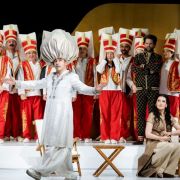
Despite the ultra colourfullness of the costumes in the very first scene, misleading us at first glance to think this may be a comedy or a historical parody, Handel’s Belshazzar is a structurally sophisticated oratorio, having just celebrated its 281st anniversary since its premiere in 1745 at the King’s Theatre London. At the Komische Oper Berlin, it is presented neither with the devotional aura of Messiah nor the theatrical pedigree of the Handelian operas, but something more elusive: a hybrid form in which political allegory, sacred history, and operatic impulse coexist in uneasy equilibrium. What looks, at first glance, like Baroque confectionery – an explosion of colour and stylised gesture in Herbert Fritsch’s production, gradually reveals a work of rigorous architecture and moral severity.

The story, drawn from the Book of Daniel, is one of terminal hubris. Belshazzar, king of Babylon, presides over a regime of spectacle and sacrilege, while the Persian prince Cyrus plots and advances with implacable calm. At the height of the king’s intoxicated self-display comes the famous prediction with a disembodied hand tracing its verdict – Mene, Tekel, Upharsin – numbered, weighed, divided. God has counted your kingdom, judged it and found it wanting and thus condemned its downfall. Judgment here is neither deferred nor metaphorical; it is immediate, almost bureaucratic in its finality. Babylon falls overnight, and with it a system of power built on desecration and denial. Threaded through the political narrative is a more intimate one: the figure of Nitocris, a mother watching her son unravel in full public view.


Fritsch, who also designed the sets and costumes, situates the entire action on a monumental staircase flanked by ornate balustrades – a space at once ceremonial and abstract, suggesting both ascent and inevitable descent. His visual language is categorical: the Babylonians erupt in kaleidoscopic multicolour excess, the Persians appear in monochrome cobalt blue, functional and collective, while the Jews, in black and white, occupy a plane of ritual and restraint. Each group moves according to its own choreographic code, forming a kind of kinetic counterpoint to Handel’s choral writing. The result is less a narrative staging than a system of signs, an attempt to give physical contour to a work whose true dramaturgy resides in the music. This is further underscored by the lighting effects by Olaf Freese, alternately flattening the stage into graphic backlit tableaux or opening vistas of unexpected depth.

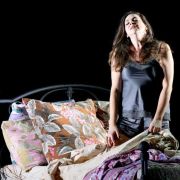
One figure is permitted to break the pattern. Nitocris, sung by Soraya Mafi, moves with a freedom denied to others, her gestures oscillating between Baroque formality and natural informality. Mafi’s soprano, finely shaded and alert to text, charted a persuasive emotional arc – from dignified admonition to near-hysterical grief – culminating in moments of startling intimacy, as when she cradled her fallen son with a tenderness that briefly suspended the production’s stylised surface.

As Belshazzar, Robert Murray offered a portrait less of tyrannical force than of brittle authority; the voice, light and sometimes pressed, did not always command the space, which in this context may read as interpretative choice or simple limitation. Susan Zarrabi, as Cyrus, brought a welcome steadiness, her presence grounded, her phrasing clear and purposeful. Together with the Assyrian leader Gobrias, sung here with appropriate bass gravitas by Philipp Meierhöfer, they plan to raid the city during the Sesach festival. Countertenor Ray Chenez’s Daniel, though elegantly shaped, was often far too discreet to register fully in the fairly dry acoustic of the Schillertheater.


The evening’s stars, however, were the choral groups. Under David Cavelius, the combined forces of the Komische Oper Chorus and the Vocalconsort Berlin achieved a level of precision and expressive unanimity that gave the performance its true dramatic weight. Handel’s choruses – by turns ceremonial, militant, and contemplative – emerged here not as interludes but as engines of the action, articulating the collective psyche of each faction.

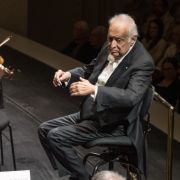
In the pit, George Petrou led the orchestra with a keen sense of momentum and colour. The continuo group – cello, theorbo, cembalo, organ – provided a supple harmonic foundation, while the orchestral textures retained a pleasing transparency. Petrou favoured forward motion over monumentality; the result was a reading that captured both the often frenetic atmosphere of the scenes and their distinctive Handelian melodies, ranging from dramatic to melancholic.
Nearly three centuries after its premiere, Belshazzar can feel uncannily current. One cannot but connect this biblical story, brought to life by Handel's music, to today’s headlines. It is all too close to home. Its vision of a society intoxicated by its own image, blind to impending collapse, requires little interpretative stretching. Fritsch’s production, for all its stylisation, does not obscure this resonance.