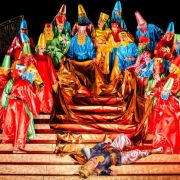
The urge to make opera appear contemporary by grafting on elements from popular entertainment is hardly new. Yet the new production of Mozart’s Die Entführung aus dem Serail at the Staatsoper Berlin raised a familiar question with unusual insistence: how much intervention can a work absorb before it begins to resist its own identity?

Musically, the evening was in capable hands. Conductor Thomas Guggeis drew transparent and inspiring playing from the Staatskapelle Berlin, and a young cast delivered Mozart’s music with conviction. The difficulties arose elsewhere. Director Andrea Moses transforms the opera into a hybrid of Singspiel, stand-up comedy and cabaret, a concept that rarely deepened the work and often competed directly with it.
Entführung follows the Spanish nobleman Belmonte, who travels to Turkey in search of his beloved Konstanze. She, together with her maid Blonde and Belmonte’s servant Pedrillo, has been captured by pirates and sold into the household of the ruler Bassa Selim. An escape attempt fails, but in a final gesture of Enlightenment humanity, the Bassa forgives the captives and grants them their freedom.


The opera’s dramatic framework belongs to the 18th century, but the emotions expressed in Mozart’s music – love, loyalty and longing – remain endlessly contemporary. Moses’ staging appears unconvinced. Her concept repeatedly suggests that the material requires supplementation, correction or even rescue. To that end, Moses enlisted the popular German comedian Bülent Ceylan, who appears both as himself and as Bassa Selim. On paper, the idea has possibilities. The spoken role of the Bassa has often invited experimentation and Ceylan possesses undeniable contemporary stage charisma. Yet the concept soon undermines itself. As moderator, commentator and comic interloper, Ceylan continually interrupts the action with routines drawn from his stand-up repertoire, many revolving around cultural stereotypes and observations about German-Turkish identity.
Some jokes land; many do not. A line about two failed marriages generates predictable laughter. Audience-participation gags produce polite amusement. More problematic is the cumulative effect. The inserted material extends the evening by nearly an hour and shifts attention away from Mozart’s carefully balanced dramatic architecture.

The dual casting creates a further difficulty. Ceylan’s comic persona overwhelms his portrayal of Bassa Selim. Dressed in little more than a succession of costumes and speaking in an intentionally exaggerated German-Turkish accent, he never acquires the moral authority that makes the final act of clemency dramatically meaningful. The character thus becomes another punchline, and the opera loses one of its central dramatic pillars.
Raimund Bauer’s set places the action on a marina dominated by a luxury yacht, its multiple levels allowing fluid movement between scenes. Two large video screens flank the stage, alternately displaying pop-art graphics and live footage captured by Ceylan himself. Anja Rabes dresses the principal characters in contemporary attire while outfitting the chorus and the Bassa in deliberately exaggerated costumes that reinforce the production’s parodistic tone.
What suffered most was not the plot but the music. Mozart’s score unfolds in long spans of emotional concentration, but again and again, those spans are interrupted by spoken comedy. The result feels less like a dialogue between old and new forms than a competition for attention. The singers seem to inhabit one performance while the comedian inhabits another.


Adela Zaharia brought elegance and emotional sincerity to Konstanze, shaping her formidable arias with poise and technical assurance. Serafina Starke’s Blonde was spirited, witty and vocally agile, fully aware of the character’s independence and charm. Siyabonga Maqungo sang Belmonte with a warm, unmistakably Mozartian tenor, his lyrical phrasing lending credibility to the young nobleman’s devotion. Michael Laurenz proved an engaging Pedrillo, combining comic instincts with an increasingly impressive tenor voice. As Osmin, David Steffens sang solidly, though the production gave him little opportunity to develop the character’s darker dimensions.
Throughout the evening, Guggeis worked tirelessly to maintain musical momentum. The Staatskapelle responded with refinement, delicacy and rhythmic vitality. Their performance served as a reminder of what remains at the centre of the work: Mozart’s extraordinary ability to elevate even the most conventional dramatic situations into something psychologically acute and emotionally truthful.

This production ultimately leaves one pondering a question that opera houses have wrestled with for decades. Must opera borrow the language of comedy clubs, television, rap or social media in order to remain relevant? Or does relevance emerge from the ability of great works to speak across centuries without excessive mediation?
Nearly 250 years ago, Antonio Salieri formulated the debate in the title of a short opera: Prima la musica, poi le parole – first the music, then the words. This Entführung proposes a different hierarchy. Whether audiences find it persuasive may depend on how much they value Mozart’s voice amid all the others competing to be heard.