If Haymarket Opera were to run Sunday school classes, one might find more takers for Bible stories. Their rendition of Marc-Antoine Charpentier’s David et Jonathas, a work situated at the complicated genre-intersection of opera, sacred drama, French Baroque rhetoric and biblical tragedy, took up the reins of musical argument and delivered a painful, beautiful meditation on the moments in which one is pulled between love and duty, individual meaning and collective need, friendship and kingship. While most of us can’t relate to King David’s political destiny, it was impossible for listeners not to relate to the emotions of the dilemma.

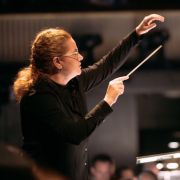
Led from the harpsichord by Jory Vinikour, Haymarket Opera’s performance was an exercise in playing to the edge; rather than leaning into the ostentatiousness that the Baroque period is known for, the work thrived in the perfection of restraint, turning from one emotion before it became too indulgent, winding down a celebration before it became too opulent. The effect was a gripping realism that the era was not known for.


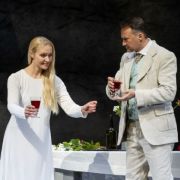
The performance was billed as semi-staged, although that description proved generous. There were no costumes or props, and little in the way of visual or theatrical world-building beyond thematically appropriate artwork projected with the surtitles. What staging there was came mostly through light but effective acting, along with a few entrances and exits for non-choral characters. Yet even without staging, the musical quality of the ensemble was substantial enough to transport the audience into the world of David, Jonathan and Saul, not just the political scenario, but the apparently irreconcilable drama of existing as tender people in the midst of a holy war.
The most distinct and delightful voice was found in none other than the Witch of Endor, with tenor Justin Berkowitz riddling the operatic trope of the gender-bent witch with almost magical amounts of care. Not relying merely on pitch for an androgynous vocal effect, Berkowitz shaped his vowels and pointed each word in such a way that created perfect doubt, rendering a character both nurturing and dangerous, placing his instrument into a fach of his own.
Leo Radosavljevic, a versatile bass-baritone, shook the room as the otherworldly voice of Samuel, then returned with an emotionally complex Achis, King of the Philistines. The contrast between ghost and general was reflected clearly in both his acting and his vocal approach, no costume change needed.
Scott Brunscheen’s tenor was remarkable for his ability to hold steady and waver as emotionally appropriate, persuasively relaying both David’s dignity and his suffering. When he sang, it seemed as if war were a distant thought, the theopolitical struggle rightly portrayed as happenstantial background to precariously placed brotherly love.

Choral numbers were crafted as an astute emotional counterpoint to the focal characters, reinforcing in their many flavors of jubilation the horrible truth that life goes on – sometimes beautifully – in the midst of national upheaval and personal tragedy, the very tension with which David, Jonathan and Saul each struggled in different ways. From the choir, Kimberly McCord offered a reliable, strong soprano that filled the hall with ease, while Hannah De Priest stood out for a brilliant, richly colored sound.


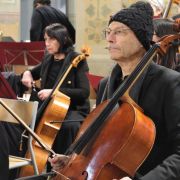
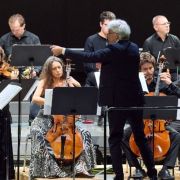
Energetic, occasionally leaping up from his instrument, Vinikour’s conducting strength was well situated in his enthusiasm for the piece, and his advocacy for its correct playing. Positioned between choir and soloists, the instrumentalists seemed fully aware of the sonic world they were participating in, raising their voices in artistically meaningful ways, but never crushing the human song.
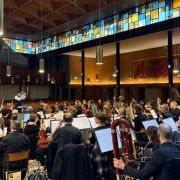
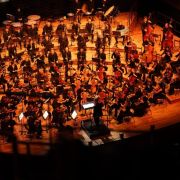
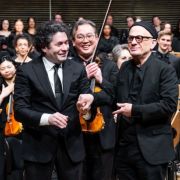
With a dozen singers and just over a dozen instrumentalists, the group was perfectly situated in the acoustically gifted Gannon Concert Hall. No moment underpowered, nor any excess, the sound felt custom-tailored to the room, surrounding the audience so neatly that it seemed that if one were to somehow dig out a hymnal containing the libretto, it would be perfectly appropriate to join in, if quietly. Members of the public were moved both emotionally and physically, dancing along in their seats, gasping at moments of profound musical execution, and producing torrential applause.
Even if this performance was not enough to convince Bible-attached religious communities to reconsider what they sing together and why, surely Haymarket has provided sufficient musical justification for additional art performances of their interpretation of Charpentier’s work, perhaps even with full staging, or at the very least a decent wig for the Witch of Endor!