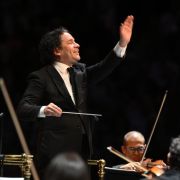
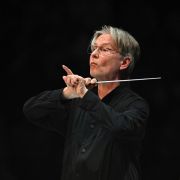
A day luxuriating in the gift of Spring sunshine was crowned by the superlative playing of the London Philharmonic Orchestra at the Royal Festival Hall, supporting a very fine double act in the persons of Kirill Karabits and Nikolaj Szeps-Znaider. Baton and violin, formally not even close relations, donning the cloaks of the best sort of magician, those who entrance and delight by an inscrutable artlessness.

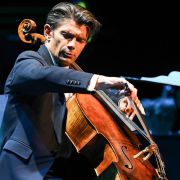
Szeps-Znaider gave an imposing performance of Bruch’s Violin Concerto no.1 in G minor, aiming straight for the heart and scoring a direct hit. A big man with a big tone might be expected to overwhelm all those around him, but it was not so; his experience as a conductor was to the fore in working with Karabits and the orchestra to craft a reading full of character and studded with highlights of expressive sophistication. He has a well-developed understanding of ‘tempo rubato’, finely balancing the fizz of virtuosity with an arching melodic line. Rapturous, without a doubt.


To conduct Anna Thorvaldsdottir’s Catamorphosis, Karabits mounted the podium as if he were a high priest all set to officiate at a solemn ritual, and indeed that is what happened. The piece is a 20-minute climate change Jeremiad which, in the words of the composer, “is characterised by the orbiting vortex of emotions and intensity” attendant on the impending “catastrophe”. I have no means of knowing whether the conductor and the orchestra all support the composer’s views on “risking utter destruction”, but they gave a very intense exposition of a dark and mournful narrative. Thorvaldsdottir’s tonal palette is a fascinating amalgam of sonic gestures which require full-on concentration to lift them off the page; it cannot be said that conductor and orchestra were not fully engaged in that endeavour, but it was heavy going.
In marked contrast, after the interval Karabits bounded onto the podium, took a deep breath, and set off at a cracking pace as he accompanied Beethoven’s Sixth Symphony on its pastoral jaunt. He had for companions a joyful band of players clearly very happy to be relieved of ceremonial duties. They skipped and frolicked in the woodland, had great fun imitating the birds, and merrily stomped with the peasants, steins fully-drained. Even when the weather broke they did not run for cover but revelled in the exhilaration that summer rain can bestow. And when the sun decided to stop playing hide-and-seek, the sated band of ramblers knew it was time to wend their way homewards, arm in arm. The sense of camaraderie evident in such a performance was manifest in all sections of the orchestra: the woodwinds and brass played with refined fluidity; the deployment of the strings vividly brought to life the embedded antiphonal elements of the score; and the timpanist, Simon Carrington, was a frightening thunderer. Herbert von Karajan would not have approved, but it wasn’t his show; that honour belonged to Karabits and the LPO.