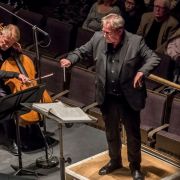
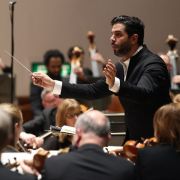
Opening the Bridgewater Hall’s 30th anniversary International Concert Series, the NDR Radiophilharmonie brought dizzying drama and exquisite beauty from Hannover to Manchester in a programme of Beethoven and Brahms. Visiting international orchestras to Manchester are an increasingly rare breed, with touring ensembles often struggling to compete with resident orchestras for audience. The Bridgewater Hall’s early days, with its visits from the major orchestras of Chicago, Vienna, Amsterdam and San Francisco, are a distant memory. It was therefore gratifying to see a reasonably full house turn out for the Hanoverians, conducted by their outgoing Chief Conductor, Stanislav Kochanovsky.

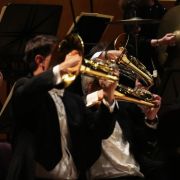
With horns seated in the trumpets’ usual place, and cellos and basses aligned towards the left, the opening chord of Beethoven’s Egmont overture was striking in its own right. Kochanovsky seemed to linger for an eternity on that brassy pause, as if giving the orchestra and audience maximal acquaintance time. The rest of the introduction was meaty and rich in reverb from the low strings, playing with total assurance way behind the baton. The Allegro was a sharp contrast: lean and muscular, crisp in wind articulation and punchy dry timpani. As would be the case all evening, woodwind solos were closely attended to, each given rich character and shape, and dynamic contrasts were wide.


Replacing an indisposed Ingrid Fliter, Lise de la Salle was soloist for that most introverted of Beethoven’s piano concertos, the Fourth. Her dreamy opening was born of utmost serenity, stately in tempo and delicate in timbre. From here, the first movement unfolded with ever increasing drama, with Kochanovsky driving a big-boned, romantic sound world full of heavy vibrato and supple tempi. The recapitulation and the piano’s cadenza were particularly thunderous. Although the coda was exquisitely soft, one wondered if there might have been space for greater introspection elsewhere, especially when textures occasionally threatened to become a little muddy.

The second movement more than made up for this full-barrelled approach. There were some magical pianissimo interactions between piano and violins, and the Kochanovsky conjured a remarkable sense of spaciousness in the silences and spaces between phrases. The finale followed with impish humour and no shortage of piano fireworks. A heartfelt encore of Schubert’s An die Musik was an elegant digestif.
Brahms’ Fourth Symphony was undoubtedly the highlight of the evening, here presented with ultra warm string sound, unhurried tempi and crystalline textures. The rich detailing of dynamic contrasts and phrasing seemed to give this familiar music a new coat of varnish, with melodic lines as seemingly weightless as the Concertmaster, who not infrequently seemed to be about to spring to his feet. The drama of the first movement’s last pages was utterly compelling.


After a slow movement which was serenely elegant rather than overly profound or ponderous, the Scherzo returned to the punchy crispness of Egmont. The finale then panned out with a totally convincing sense of architecture. The most memorable moment was probably the exquisite flute solo in the central section, which was seemingly suggestive of both existential crisis and tender consolation. It was hauntingly beautiful, and was followed by the long-awaited and ultra-dignified trombone chorale. From here the music became ever more impassioned through the final minutes of the symphony. This was one of the best performance of Brahms 4 I have ever heard, and was deservedly well received by the audience. A quick Hungarian Dance encore sent them home on a high.