Adrian Danchig-Waring may have bounded onto the Koch Theater stage for the last time on Sunday, but his influence will be felt for years to come – well beyond New York City Ballet. He has led the company’s New York Choreographic Institute since 2018 and will continue to do so. In a recent interview, he described his vision for the Institute as “something like Bell Labs meets the Ballets Russes”.

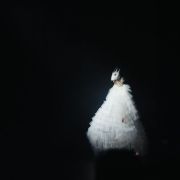
But Sunday was all about Danchig-Waring’s dancing. For his farewell, he chose two Balanchine black-and-whites and Lar Lubovitch’s pandemic-era duet, Each in Their Own Time, with Taylor Stanley. Pam Tanowitz supplied a world premiere, Once With You, a lark for Danchig-Waring and three of his muses: Indiana Woodward, Unity Phelan and Mira Nadon.
Tanowitz’s work is often described as being “in conversation” with past innovators like Balanchine, Robbins and Cunningham. This new piece feels more like Tanowitz rummaging through their wardrobes, yanking out pieces and running them up a flagpole in a frenzy of indecision. The women hopped on brittle pointes as Danchig-Waring tumbled charmingly in from the wings. They chugged, hand to brow, alternating bourrées with step-ball-change. Sweetness and casualness prevailed, punctuated by flashes of virtuosity and glancing references to Apollo, 4T’s and others I’m sure I missed.


Crimson unitards – with blue splotches on Danchig-Waring’s recalling first Léon Bakst’s designs for Nijinsky’s Faun, then Matisse’s têtes – enhanced the playful mood. The music did not: spare, gloomy Beethoven, with stabbing cello pizzicato, more evocative of a murder scene than a romp. Tanowitz engaged with its rhythms and phrasing only in fits and starts. The whole thing was over in a New York minute, but let’s hope it returns so we can wrestle some more with its cerebral puzzles.
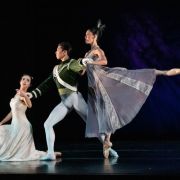
The Four Temperaments remains as astonishing and inventive as it must have seemed at its 1946 premiere. The first 30 seconds of the opening theme trace a kind of origin story – beautifully illuminated by Ava Sautter and Shane Williams – from a ceremonial offering of hands and beautifully shaped feet thrust into each other’s space, to the world-encompassing sweep of Sautter’s arabesque leg as she promenaded in a deepening tilt. Veteran corps dancer Meaghan Dutton-O’Hara, newly promoted to soloist, and the noble Oscar Estep gave a soulful account of the Third Theme, my favorite pas de deux in the Balanchine universe. Slinky, full of tricky level changes and swivels on pointe, it felt like two people sharing a secret.

In Melancholic, Taylor Stanley rendered a paragon of anguish light and lithe. Naomi Corti made a bewitching Sanguinic, contrasting sharp leg flicks and stop-on-a-dime turns with luxuriant back arches as she flung a leg skyward, tipping thrillingly on pointe. Danchig-Waring’s Phlegmatic was a philosopher or mathematician intent on solving a problem that manifested as a complex web – comprising the sterling Savannah Durham, Becket Jones, Lucie Richard and Kylie Vernia – in which he himself eventually becomes enmeshed. He opened his chest softly, reverently, to the sky and its vast possibilities, then convulsed in staccato pulses as if momentarily plagued by doubt.
Emily Kikta’s magnificent Choleric whipped the troops into action with explosive kicks and jumps, her feet stirring eddies high in the air. As the curtain fell, four women sailed through the air in huge grand jeté lifts along runways formed by the ensemble, their arms punching through the clouds with a snap of the wrists, heads thrown back – none more exultantly than Dutton-O’Hara.


Agon carried on the modernist project a decade after 4T’s, crowned here by Danchig-Waring and Phelan’s risk-taking central duet. Big, skimming moves turned into a sudden confrontation with the audience, her leg hooked around his torso. She melted and disentangled herself from his grasp; he flew her down the diagonal, her legs split like the propeller of a Spitfire.
David Gabriel made a cool and rhythmically deft debut in the first pas de trois, boosted by blithe yet incisive support from Sara Adams and India Bradley. Dominika Afanasenkov was stunningly assured in her debut in the second, despite rocky support from her partners.

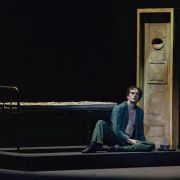
Danchig-Waring’s most deeply felt performance came in the Lubovitch duet. He and Stanley came together only glancingly; the mood was not romantic, despite an early gesture in which he ran his hand down Stanley’s arm, almost absent-mindedly. He soared, almost recklessly, his beautiful airborne shapes recalling past performances in Merce Cunningham’s Summerspace, where the dancers evoked organic forms in nature, and in his rarefied interpretation of Apollo.
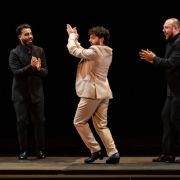
At the close of an extended curtain call, as his partners and colleagues emerged to salute him, his husband handed him the prop lute from Apollo. Danchig-Waring held it proudly aloft as he bounded skyward one last time.