The Dutch National Ballet presented three contemporary works entitled Masters of Movement. While the evening was aptly titled for audiences to appreciate three different choreographic points of view, in today’s cultural landscape, it’s a bit questionable when the Masters being lauded all happen to be white men. While the Masters-at-hand put the dancers through their paces which highlighted the company’s exceptional calibre and artistry, the programme on a whole felt somewhat uneven.

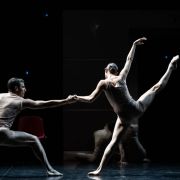
The programme began with David Dawson’s Empire Noir; a work created for the Dutch National that premiered in 2015. Empire Noir is a contemporary work that takes place in a liminal void that sharply focuses its lens on the dancers and their virtuosic abilities. The five women and men dance both together and separately, slicing through the space in exaggerated articulations, syncopated movements and daredevil lifts.
If there’s any piece that showcases the Dutch National’s exceptional execution and mastery of contemporary ballet, it’s Empire Noir. Here, Dawson has thrown in everything and the kitchen sink for the dancers to get their teeth into. The piece was very much about lifts with the men propelling the women into the air in complicated formations or hooking their hands under their arms and dragging them along the floor to dazzling effect. While the cast had a strong showing from its principal dancers, I found Joseph Massarelli’s buoyant energy quite impressive, as well as Lore Zonderman’s interpretive movement, sultry and eye catching. Tristan Simpson showcased a dynamic adagio that he expertly manoeuvred, accentuating his leg and arm extensions.


There’s a kind of cool aesthetic to Dawson’s work that seems dangerously close to being one note. Still, this feels like a contemporary work that dancers truly like to luxuriate in. The original music, created by Greg Haines, married seamlessly with Dawson’s slick signature dance style.
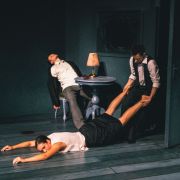
Solitude by Alexei Ratmansky was the only work of the night that was not created on the Dutch National but for New York City Ballet in 2024. Staged by retired Principal dancer of New York City Ballet, Andrew Veyette, Solitude had the distinction of being the only contemporary work that evoked a narrative structure. Set to Gustav Mahler’s ‘Funeral March’ the ballet conveys the choreographer’s own complex emotions towards war.

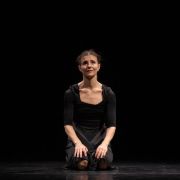
The central dancer, movingly portrayed by Giorgi Potskhishvili, kneels beside the still body of a young boy while dancers move solemnly around them. The ensemble evoke moments of love and loss or memories of people with a familial connective tissue who haunt the protagonist from the afterlife. It was beautiful to see Potskhishvili embody this character that seemed to resonate with him on a deeply personal level. He’s so in tune with his physical instrument that it’s apparent what a rich storyteller he is, even when he is perfectly still. His solos were nuanced and well balanced between balletic bravado and the weightiness of the ballet’s subject matter. I was quite moved to see this side of him and I look forward to seeing more of his lyrical qualities in other contemporary works. Sebia Plantefève-Castryck also moved throughout the piece with a quiet confidence and assuredness. She seems to be one to look out for in the future.

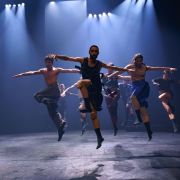
While choreographer and Artistic Director of the Polish National Ballet, Krzysztof Pastor, has probably the closest ties with the Dutch National Ballet – having both danced with, and started his choreographic career with the company – his closing work for the night, Refraction, resonated with me the least.


The examination of water and light through movement felt a bit middling as a concept and the separate sections of ensemble work and principal duet with Jessica Xuan and Jan Spunda felt more disjointed than complementary. Tatyana van Walsum had some interesting ideas for the stage and costume design but I’m still on the fence on its execution. I’m not sure what the iridescent blinds added to the piece other than a touch of shimmer for entrances and exits, and the gender neutral blue body suits with additional sheer pants felt more distracting than innovative. Nonetheless, the Dutch National Orchestra sounded beautiful playing Philip Glass’ Violin Concert No. 1 with solo violinist Sarah Oates, under the conductorship of Nathan Brock.

Perhaps the evening on a whole was tempered by its programme arrangement. While the dancers were in top form I think I would have preferred for Pastor to open the evening, followed by Dawson and ending with Ratmansky. A little dazzle to begin with and ending with depth.