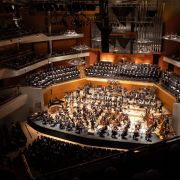
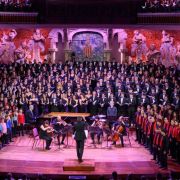
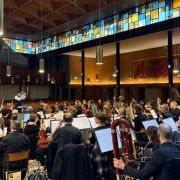
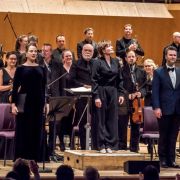
The BBC Philharmonic Orchestra’s programme for The Black Lights festival traced the evolution of minimalism and its influence on contemporary orchestral writing. From the microtonal instability of Oliver Leith and the hypnotic processes of Terry Riley to the world premiere of a new work by Mica Levi, the first half explored repetition, texture and timbre in contrasting ways before culminating in the expansive orchestral vision of John Adams’ Harmonielehre.

Oliver Leith’s Pearly, goldy, woody, bloody, or, Abundance (2022) is a slow-moving orchestral work in which players are asked to alter their tuning by varying degrees, creating an increasingly unsettled sound world. The strings, in particular, handled the demanding microtonal adjustments with remarkable precision. Leith also requires the players to add indistinct vocalisations, deepening the work’s eerie atmosphere. The music constantly shifts between consonance and dissonance; each fleeting moment of unison brought a welcome, if short-lived, sense of relief.


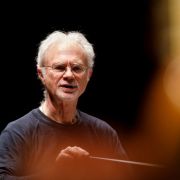
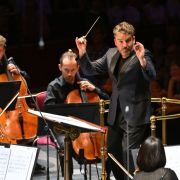
Terry Riley’s seminal minimalist work In C formed the centrepiece of the first half. The complexity of coordinating the ensemble was evident in conductor Ludovic Morlot’s consistently clear gestures. Shimmering textures gradually accumulated into a vast ocean of sound, with layers emerging and receding in perfectly judged balance. Every strand remained audible within the intricate texture, allowing the work’s evolving patterns to retain their clarity. By the close, Morlot appeared genuinely delighted with the BBC Phil’s performance.
The first half concluded with the world premiere of Mica Levi’s untitled new work, co-commissioned by The Black Lights, BBC Radio 3 and the BBCPO. A short violin fragment opens the piece, repeated and gradually extended with each iteration. Beneath it, lower strings and timpani introduce new layers, the latter frequently providing the music’s subtle momentum. Sustained consonant chords support increasingly intricate violin figurations before major harmonies slowly give way to minor, gently oscillating between the two like a pendulum. As the music loses momentum, the distinction between the harmonies becomes increasingly blurred. Brief woodwind fluttering precedes an abrupt ending, after which Levi took to the stage to acknowledge the warm applause.

John Adams’ Harmonielehre provided a striking contrast. Although still rooted in minimalist techniques, its broader structure and expressive sweep offered a more cohesive musical argument. Rather than exploring orchestral colour through experimentation alone, Adams harnesses tonal harmony to create an expansive emotional landscape. Morlot shaped the opening movement with crisp articulation and sharply defined contrasts between its driving rhythmic passages and more lyrical episodes. The motoric rhythms possessed tremendous energy without ever becoming mechanical.


The darker second movement provided a welcome change of atmosphere, its brooding intensity contrasting effectively with the outer movements. Once again, the BBCPO played with exceptional assurance, fully capturing the work’s emotional depth. The finale combined mystery and grandeur, its cinematic scale brought vividly to life by Morlot, who clearly relished the score’s climactic moments. The result was a compelling and triumphant performance.
An encore followed in the form of Parry’s Jerusalem, an unexpected choice that proved less successful. Morlot encouraged the audience to sing, but few appeared confident enough to join in, and the response was hesitant. Rather than sustaining the excitement generated by the concert – and by the younger audience drawn to The Black Lights festival – it brought proceedings to an oddly subdued conclusion, leaving the evening to end on a more reflective than celebratory note.