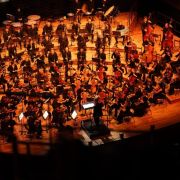
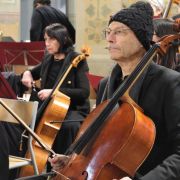
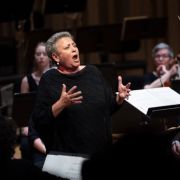
Paris is home to around ten amateur orchestras – and many more if we include chamber ensembles, groups that come together for a single programme or small brass bands. In a series of three articles, we set out to explore these orchestras, from rehearsals to concerts, to gain a better understanding of what drives them and what they reveal about our collective relationship with music. Following a first instalment devoted to Ut Cinquième and a second devoted to Elektra, it is now the turn of Ondes Plurielles and the COGE in this third and final part.

Ondes Plurielles was born out of a desire to perform a particular score: Schoenberg’s Verklärte Nacht. Alice, violist, director of cultural affairs for a local council and its founding chair, describes those beginnings in 2017. “The musicians wanted to decide on the programmes and choose how things would work.” Today, the orchestra is over 120 strong. Unlike Ut Cinquième, which rehearses every Wednesday, and Elektra, which meets every Tuesday, Ondes Plurielles operates in projects: three weekends of rehearsals, one weekend of concerts, ten projects a year. Musicians sign up for one, several or all of them, depending on their schedule. “The great thing about being an amateur is that we have no constraints apart from the financial side of things. But above all, we play whatever we feel like. It’s a bit of a luxury as a musician.”


Marie-Christine started playing for Ondes Plurielles when she retired, after a professional career of a kind you don’t see much of these days: forty-three years at the same small organisation… called the Orchestre de Paris. She was a violist. Alice recounts her arrival: “We received an email from Marie-Christine saying she’d just retired and was looking for a new orchestra. She asked politely, very modestly, if she could come and play with us. Since then, she’s been the one who’s played the most over the years; she hasn’t missed a single session.” And when a musician from the Orchestre de Paris attends an Ondes Plurielles concert, Marie-Christine introduces them, says Alice with a smile, “as members of her new orchestra”.

Marie-Christine hands out earplugs at the entrance to Saint-Marcel Church before the concert. It’s essential: in a dry and precise acoustics with an orchestra taking up half the church, Shostakovich’s Seventh really packs a punch. “They’re incredible”, she says. “They have such a love of music, such a presence. It’s an immense pleasure every single time.” She admires her new colleagues. “I wonder how they manage to work so much: three whole weekends taken up. They’re only free in the evenings. In a professional orchestra, relationships can be a bit strained. Here, the human relationships are different: I’m happy to see them, to be with them.” And then this simple, definitive statement: “The word ‘amateur’ is so true. They’re the ones who give their all for the music.” Marie-Christine, 43 years with the Orchestre de Paris, eight years with Ondes Plurielles: a violist for life.
No sooner has the applause died down than the musicians start packing up. They have to hand the church back, and quickly. Chairs are folded up, music stands put away, crates are carried off. The conductor, Johannes Le Pennec, lends a hand too. These people who, as he puts it, “work 35 to 45 hours a week in their day jobs”, are the ones who transported and hired the equipment, set up the raised platforms, performed the concert, and are now packing up. “Their energy levels are absolutely crazy.”

Access to rehearsal and concert venues remains the most persistent challenge. COGE, the oldest amateur orchestra association in Paris – founded 43 years ago by students from the grandes écoles who wanted to make music together – has struggled to find space in nursery schools, hospitals and canteens, only to be shown the door each time for one reason or another. At the time of this interview, Léa Mpungu, the orchestra’s director and a cellist, had just learnt that her current rehearsal venue would not be renewing the agreement. “For the third year running, I’m going to have to find a venue, and I’m already three months behind,” she says, visibly stressed.


Yet the COGE comprises 300 musicians spread across three distinct ensembles, a volunteer management team of around thirty people, stage managers, a communications team and a webmaster. “It’s a behemoth,” says Léa. “I can’t understand why the City of Paris, with such a thriving scene of amateur orchestras, isn’t doing more. Finding a venue in Paris is a nightmare.” She has phoned town halls and music colleges. They tell her they have their own orchestras. Schools get cold feet when she tells them the orchestra can swell to 110 people when there’s a choir included. The financial model is also under strain: “Without grants or patrons, we’re running a serious deficit.” And when the deficit mounts up, the repercussions are immediate: “No copyrighted works, so goodbye to Sibelius, whom everyone adores. No Requiem with soloists. And in the current climate, I can’t see how this is going to improve.”
And yet, every five years, the COGE organises its anniversary concert in a major Parisian venue. The Salle Gaveau in the past, the Philharmonie for the 35th anniversary, Radio France for the 40th. On those evenings, the two orchestras merge, and all the choirs sing together. In 2022, it was the finale of Mahler’s Second with Alizé Léhon conducting, who has since been named “Revelation Conductor” at the Victoires de la musique classique. Léa recalls: “We were all in tears on stage, firstly because that piece is indescribable. And there were 300 of us on stage with Alizé, standing at just one metre seventy, making us play this insane music. It’s a bit like the concert of a lifetime because that sort of occasion doesn’t come along often. And sometimes”, she continues, “we marvel at little details, like ‘look, this chair’s adjustable!’”
In a city where, in the space of a single week, you can hear the Orchestre de Paris, the Orchestre Philharmonique de Radio France, the Orchestre National de France, the Orchestre de Chambre de Paris and – depending on their world tours – the orchestras of London, Cleveland, Dresden, Los Angeles or the Met, these amateur ensembles exist, are multiplying, are competing. In these halls with sometimes catastrophic acoustics, these freezing gyms, these company canteens, hundreds of Parisians continue every evening to take out their instruments, settle onto an uncomfortable folding chair, wait for the conductor to raise his arms, and play masterpieces from our musical heritage, in which they “will give their all for the music”. How can one not love these amateurs?
Translated from French by David Karlin