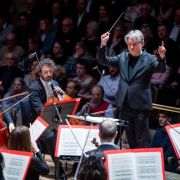
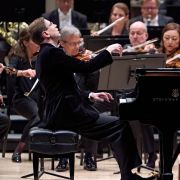
Several days after giving the world premiere of Philip Glass’ Symphony no. 15, “Lincoln”, the Boston Symphony Orchestra began the first full weekend of the Tanglewood Festival with a turn from civic gravity to gala glamour and the safer pleasures of Tchaikovsky. Under Music Director Andris Nelsons, the programme paired the public virtuosity of the First Piano Concerto with the theatrical lyricism of Swan Lake.

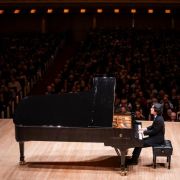
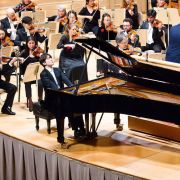
A frequent BSO collaborator, Seong-Jin Cho brought his customary refinement to the concerto, resisting the temptation to overstate its grand gestures. The opening had breadth and weight without bombast. Nelsons allowed the orchestral introduction to unfold expansively before Cho entered with firmly projected chords that sounded more cultivated than thunderous. Throughout the first movement, his passagework remained lucid, the secondary themes sensitively shaped and the dynamics finely controlled. The pianist brought an almost Schumannesque quality to the cadenza, investing it with fantasy and introspection rather than bravura. Taken as a whole, however, his interpretation revealed more control than spontaneity. Nelsons kept the orchestral frame spacious and supportive, giving the more intimate episodes room to come fully into their own while maintaining momentum.


The Korean pianist was especially persuasive in the Andantino semplice, finding genuine tenderness in music too often treated sentimentally. The central scherzando section had lightness and wit, while the opening material returned with charm and naturalness. Nelsons encouraged an unusually attentive exchange between soloist and orchestra, the piano entering into chamber-like dialogues with Elizabeth Klein’s flute, Blaise Déjardin’s cello and Keisuke Wakao’s oboe without dominating the musical discourse. In the finale, pianist and ensemble matched one another in rhythmic precision, while Nelsons kept the orchestral writing clear enough for its inner detail to register even at the music’s most exuberant moments. The excitement came not through sheer force, but from the cumulative energy of musicians listening closely to one another.
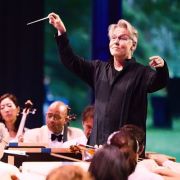
With Swan Lake, concerto rhetoric gave way to theatrical atmosphere. Nelsons established the sequence’s character in a precisely calibrated Introduction to Act 1, then drew from the BSO strings and woodwinds a rich palette of dark shimmer, elegance and melodic abundance. The episodes followed one another with such coherence that, even without the ballet’s full narrative framework, the selections never sounded like a collection of familiar highlights.

Boston Ballet principal Viktorina Kapitonova brought remarkable grace and expressive detail to the White Swan pas de deux, her eloquent movements giving the music a visible emotional contour without overstating its pathos. Patrick Yocum partnered her with quiet attentiveness. With the dancers positioned at the front of the stage, behind Nelsons’ back, the staging required conspicuous efforts on his part to keep movement and music aligned, a practical challenge that revealed how much coordination the episode required. Two summers after the BSO and Boston Ballet’s more extensive Tanglewood collaboration in Stravinsky’s Apollo, this more concentrated encounter again brought together two of Boston’s leading cultural institutions.


After the dancers withdrew, Nelsons guided the music with increasing intensity toward its impassioned, tragic conclusion. The final pages gathered force steadily, while the orchestra retained its poise. By the end, the excerpts had acquired a sense of inevitability.