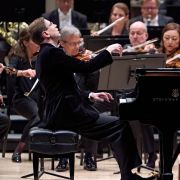
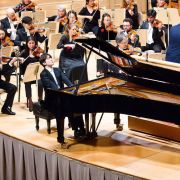
An unmistakable electrical charge ran through Carnegie Hall’s Stern Auditorium on Friday, generated by the intensity of exchanges between Yuja Wang, directing from the keyboard, and the players of the Mahler Chamber Orchestra.

That energy was already present in Prokofiev’s Symphony, which opened the programme, led from the concertmaster’s chair by Matthew Truscott. With the players standing – cellists excepted – the MCO brought a bright, incisive edge to the performance. Conceived by a young composer intent on renewing Haydnesque idioms from within, the symphony’s apparent ease gave way to persistent pressure in tempo and articulation, most evident in the outer movements. The Larghetto unfolded with a clean, unforced line, with hints of a broader lyricism that would later emerge in works like Romeo and Juliet, while the Gavotte maintained a poised simplicity. What emerged was a reading of sharpened contours, leaving the music’s humour more implicit.


The programme featured further Prokofiev, his Second Piano Concerto, marked by abrupt modernism and harmonic bite. Juxtaposed with the Classical Symphony, it might have brought into relief the coexistence of contrasting impulses across his early work. Instead, placing Chopin’s E minor concerto between them functioned as a clear cesura, a recalibration that redirected the focus inward.
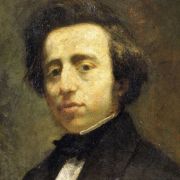
Where Prokofiev’s writing distributes musical thought across competing layers, Chopin draws it toward the piano. Yuja Wang responded with restraint, shaping the musical thread with finely controlled pianissimo and keeping the filigree light and proportionate. Nowhere was this more apparent than in the first movement’s second theme and the inward unfolding of the Romanza. The qualities that make Wang’s pianism so distinctive were evident: the poetic vein in the feather-like lightness of her touch and in her shaping of near-whispered pianissimos; the controlled brilliance of fireworks in the more virtuosic passages. Her rubato remained closely integrated with the orchestra, although coordination with the horns in the Allegro maestoso was occasionally less settled. Even at its most extrovert, her playing retained a sense of proportion and clarity, never detaching from the line.

Prokofiev’s Piano Concerto no. 2 in G minor returned to a more expansive, volatile scale. Wang introduced the wistful opening theme, hinting at mounting tensions ahead. In dialogue with the orchestra, she shaped its development as a process driven by the accumulation of sharply contrasted, almost discontinuous episodes. The pianist sustained the long span of the first movement’s cadenza with formidable command, shaping its successive surges – with their wide leaps and densely packed chords – into a continuous arc that led inexorably toward the orchestra’s return. The Scherzo’s relentless, mechanical motion was dispatched with precision and stamina, while the Intermezzo pressed forward with a heavy, almost grotesque insistence. The darker inflections of the opening theme returned in the finale in a more driven and forceful guise, tightening the work’s trajectory. The closing pages arrived with overwhelming force.


The first encore, the rarely heard, jazz-inflected Suite for Piano and Orchestra by Alexander Tsfasman, proved a relatively slight statement. Yet Wang brought to it natural rhythmic ease and stylistic flair, the syncopations articulated with precision, so that the music never sounded merely decorative. It was in the second encore, Danzón no. 2 by Arturo Márquez, that her instinct for pulse and gesture came fully into its own, the phrasing taking on a magnetic pull. Guiding the orchestral response from within the performance, Wang asserted a strong personal presence. Nonetheless, the commendable impulse did not always translate into a more compelling overall result or the level of precision a dedicated conductor might have secured.