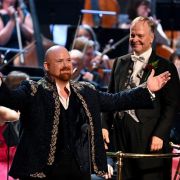
Before the encore last night, a genial Yannick Nézet-Séguin waxed lyrical about how the Met Orchestra’s trip to the BBC Proms had been decades in the planning and that it was “a marriage made in heaven”. Even allowing for a bit of grandstanding on Nézet-Séguin’s part, it’s hard to disagree. I’ve lost count of the number of occasions I’ve heard or read about an orchestra swallowed up in the cavernous acoustic of the Royal Albert Hall (our reviews often say something like “it will sound better on the broadcast”), but this orchestra plays in the similarly cavernous Metropolitan Opera House day in, day out, and the Albert Hall holds no fear for it, even when accompanying solo voice, even when playing a work full of orchestral delicacy like Mahler’s Fourth Symphony.


I can honestly say that I’ve never heard an orchestra overcome this acoustic more successfully. In the very first bars, the flute and sleigh-bell combination rang out with delicious clarity. Each bank of strings was united as one but each of their lines was audible separately from the others.The horn section was smooth as satin, underpinning the rest of the orchestra but never swamping it. Such was the phrasing and timbral quality of the woodwind lines that one had the impression that most of those players could have had perfectly good careers as soloists had they so wished. And that ability to project every part of the score was not achieved simply by playing loud: the mezzopiano and pianissimo passages were as distinctive as any others.
Truly, this is a Rolls-Royce of an orchestra, purring smoothly through this most congenial of Mahler’s symphonies, where all the tempo markings are one synonym or another for “unhurried” (“nicht eilen”, “ohne Hastig”, “behaglich”). But to break the metaphor, Nézet-Séguin wasn’t the driver of this orchestra: rather he seemed half cheerleader, half chess master, spending much of his time pointing at one or another of the musicians in turn to gain emphasis on some particular phrase.

Joyce DiDonato’s voice is itself a Rolls-Royce in this repertoire. Her child’s vision of Heaven in the final movement was bright, unmannered and childlike in exactly the way that Mahler demands, whether in the happier moments or the darker ones (“butcher Herod” and so on). Her ability to project pianissimo was nothing short of extraordinary (the sound was still rich and full, with my seat some 60 metres away)The sheer beauty of her voice shone through every line, and she thrilled with deft control of rubato. This was a blissful ending to the programme, topped only by the even more blissful encore, Mahler’s Urlicht.


Much as Mahler was a genius, I can’t help but question his judgement in the choice of poetry to set for his five Rückert-Lieder. I’m not a native German speaker, but the poems read to me as bland, trite or both. Brilliant as is the music, wonderful and passionate as was DiDonato’s voice, I found it impossible to be truly moved by them. The best, if I could imagine having religious faith for a moment, was Um Mitternacht, but even here, the explosion of devotional fervour in the last verse, as the poet declares that his only sanctuary is in God, could have done with more punch.
Kaija Saariaho’s short 2009 Lumière et pesanteur, a landscape shimmering with percussion effects, was a delicious opener for a concert which will stay long in the memory for sheer orchestral and vocal quality.