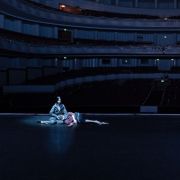
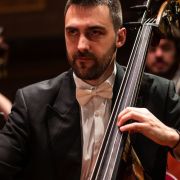
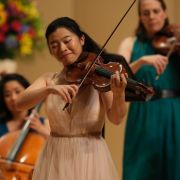
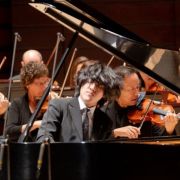
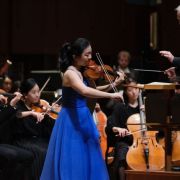
Graduates of the Curtis Institute of Music account for 43% of the Philadelphia Orchestra’s membership, occupying five principal chairs. Although the main campus sits just two blocks up Spruce Street from Marian Anderson Hall, this abundance cannot be chalked up simply to proximity. Curtis churns out the crème de la crème of classical music, and the students who don’t go on to solo careers often find places in the country’s best orchestras. It makes sense that Yannick Nézet-Séguin, a professor at the school since 2013, would conduct a public concert with the current members of the Curtis Symphony Orchestra: the young people sitting in those chairs will likely be his colleagues someday soon. They already sounded the equal of their more established peers in a thrilling account of Mahler’s Ninth Symphony.


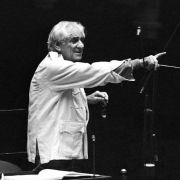
Another Curtis alum, Leonard Bernstein, famously described the halting opening of the Andante comodo as a musicalization of Mahler’s cardiac arrhythmia. Under Nézet-Séguin’s direction, instead, it sounded here like a brief attempt to synthesize ideas introduced in the composer’s eight preceding symphonies. You could glean the imposing string tremolos from the Second Symphony and the regal horn fanfares of the Third, alongside the studded, syncopated teardrops from the harp that recalled the Fifth’s Adagietto. Nézet-Séguin took his time putting the pieces together as a legato whole, then stretched rubato almost to the limit in long-breathed phrases that enveloped the auditorium. If you read this first movement as Mahler’s attempt to cling to life, this performance made a strong interpretive case.
The Lӓndler faltered slightly, its rustic, sunny exposition never fully transformed into its sinister doppelgӓnger as the music progressed. Yet perhaps to compensate, the Curtis musicians fully let loose for the Rondo-Burleske. This was barely controlled chaos: phrases rammed into each other, entrances were sometimes trampled and lyrical passages seemed rushed in an attempt to return to the greater outward expression. Somehow, though, it worked – because Mahler’s flawless contrapuntal writing can withstand a torrent of riotous energy, and because Nézet-Séguin pulled back smartly whenever matters seemed in danger of dipping too far into the anarchic direction. It showed that tumult can be sustained without veering toward disorganization.

Nézet-Séguin called the Ninth “a grown-up work” in pre-performance remarks, and that’s how the Curtis forces treated the Adagio, shorn of the wild fire that came before it. Phrases and transitions were measured and thoughtful – a putting of things in order before the end. Utterly transparent horns, lightly textured strings and rich cellos introduced the Finale’s baleful theme. Nézet-Séguin avoided dramatic mood shifts here, underlining a sense of acceptance rather than a final fight with death. (All that played out in the beginning perhaps?) The fade-to-black was wrenching in its subtle inevitability. After holding the airless silence for several minutes, the audience erupted into the longest, loudest applause I’ve ever encountered at a student performance.


The senior maestro shared the spotlight with Curtis conducting fellow Yiran Zhao, who opened the concert with Valerie Coleman’s Umoja (Anthem for Unity). Written as a quintet for Imani Winds – of which Coleman was the flautist from 1996 through 2018 – and expanded for the Philadelphia Orchestra, it draws on African and Appalachian musical conventions to present a portrait of overcoming injustice through harmony and peace. (“Umoja” means unity in Swahili.) Despite its pleasant qualities, it reminds the listener more of sweeping American neo-Romanticism than anything else: beautiful and blended, but rarely evoking the passion and edge that might be expected from Coleman’s reference points. More distinctive percussion elements and string twang would go a long way in avoiding the inevitable comparisons to Copland and Barber (another Curtis boy). Still, Zhao conducted with sensitivity, the work providing a cheerful conduit to Mahler’s treatise on mortality.