A leading Australian newspaper trolled the US in a recent article about the Oscar Wilde ballet: “A work featuring the first male same-sex kiss in The Australian Ballet’s history will travel the US in a landmark tour. How will it be received in Trump’s America?”

There’s no denying that this tale of society’s policing of male sexuality and masculinity arrives amid mounting hostility toward LGBTQ+ Americans. But it’s no accident that the company has brought it to Berkeley, California, and New York City – two places that have built strong legal and cultural bulwarks against an administration paying off right-wing evangelicals for their electoral support.
Mamdani’s America welcomed Oscar last week.

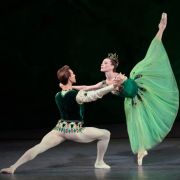
The ballet centers on the celebrated author’s downfall and two-year sentence of hard labor for “gross indecency,” offering moments of great poignancy alongside choreographer Christopher Wheeldon’s signature fluid entanglements. Freed from classical ballet’s gender conventions, Wilde’s love affairs with Robbie Ross and Lord Alfred (“Bosie”) Douglas are imaginatively limned in splendid, counterweighted partnering between Callum Linnane as Wilde, Joseph Caley as Ross and Elijah Trevitt as Douglas. Linnane also grappled with Adam Elmes as Dorian Gray, the protagonist of Wilde’s most famous novel, who haunts him in his prison cell.


The influence of David Hallberg, former ABT and Bolshoi star and artistic director of the Australian Ballet since 2021, is apparent in the men’s ultra-refined lines and tension between princely restraint and headlong emotion. Their brooding good looks add to the allure as they ensnare one another in mid-flight, dive, drape, clinch, stiffen briefly in resistance before surrendering – athleticism yielding to tenderness, and, in Oscar and Bosie’s case, the heavily marketed kiss.

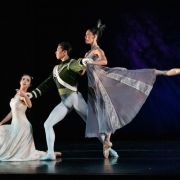
In a lighter register, an adroit pas de trois for Oscar, Robbie and Oscar’s wife Constance suggested that she was, at least initially, unaware of her husband’s attraction to men. The comedy came at her expense, which Sharni Spencer bore nobly.
Scenes from the harrowing Picture of Dorian Gray and the affecting allegory The Nightingale and the Rose infiltrate flashbacks to Wilde’s carefree years: affectionate moments with Constance and their sons, peacocking in the glittering society that embraced the witty provocateur, and the seedy sexual underworld of Victorian rent boys and posh noblemen leading double lives. Linnane vividly rendered Wilde’s descent into terror, loneliness and ill health, seeming to grow gaunter over the evening. A fine Act 2 solo conveyed his yearning and frustration. Countering this bleakness was a lush tangle of erotic encounters, frothy entertainment by Victorian drag queens, menacing vegetation confronting the Nightingale, and Dorian Gray’s murder of his portraitist, Basil Hallward.
Amid the quick dissolve of dreamlike scenes, the Nightingale emerged from the heart of a men’s bacchanal. The wondrous Grace Carroll, fluttering and stuttering on widely spaced pointes, embodied the Nightingale’s resolve to help a lovesick youth win his beloved, even at the cost of her own life. An ensemble in red masks, collectively forming a rosebush, swept her into the gnarled branches of a tree beneath a wide-eyed moon. Impaled on the thorns – hanging limp over a rigid arm thrust under hers – she died without knowing that the young man’s beloved would reject him. The wide-eyed moon wept tears of blood at her pointless sacrifice.


Before Wilde himself died, Linnane resurrected the Nightingale, sending her soaring overhead.
In another sublime merging of life and art, Elmes sprang into an expansive, lyrical solo of beauty and optimism as Dorian Gray emerged from Wilde’s pen. Ghostly and hunched, Linnane scribbled across the floor of his prison cell.
Promoted as an out-and-proud love story, Oscar is ultimately about the crushing of the human spirit. Powerful and lyrical, it makes a case for ballet’s relevance in the face of rising fascism.
For all its formal inventiveness, Oscar shortchanges Wilde’s two lovers, giving Robbie and Bosie too little dancing to establish their vastly different roles in his life: Robbie, the devoted friend who would restore Wilde’s posthumous literary reputation, and Bosie, the toxic muse whose vendetta against his father precipitated the catastrophic libel trial.

Magnetic actor Seán O’Shea was also underused. He opened Act 1 by recapping the tense state of affairs while sauntering through the courtroom amid jittery ranks of bewigged, humorless jurists. But his Act 2 narration of Wilde’s suffering in prison told us what Linnane told us in dance. Why not give him passages from Wilde’s writing to read throughout the ballet? At the end, he read a weepy poem by Bosie – very lame. Why give Bosie the last word, rather than the consummate wit himself?
A friend of Wilde’s, journalist Claire de Pratz, visited him a few weeks before his death at a rundown Parisian boarding house. Wilde reportedly complained to her of the cheap décor: “My wallpaper and I are fighting a duel to the death. One or the other of us has to go.”