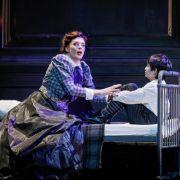
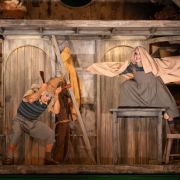
André Previn’s operatic version of Tennessee Williams 1947 play A Streetcar Named Desire debuted in San Francisco in 1998, and came to Australia in a sumptuous production by Opera Australia in 2007. This Perth version by Freeze Frame Opera is grittier, and more compelling. Philip Littell’s libretto hews close to the original play, which also gave rise to an iconic movie by Elia Kazan which many have seen, so there is thus the advantage – and the burden – of familiarity in its transposition to yet another medium. There has been some debate about the success of this rendition, and its success as opera qua opera.

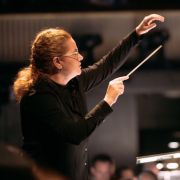
Previn’s music draws comparison with several 20th-century composers, and he admitted to the influences of Britten and Barber. There is also, appropriately, a jazz/blues inflection. This production features a pared down arrangement, by music director Tommaso Pollio, featuring cello (Sophie Curtis), clarinet and saxophone (Geoffrey Gourgault du Coudray), trumpet (Craig Pedersen) and keyboard (Pollio). The work is sung through and the singing tends to the declamatory with some lyrical sections which are not quite arias in the traditional sense.


The Liberty Theatre is an old cinema which has been stripped out, with a bank of bleacher-style seats on this occasion. There is no proscenium, but a slightly raised stage area, with the musicians seated off to one side of and slightly behind the set, designed by Rhiannon Walker, who is also responsible for the 50s-style costumes. The Kowalski dwelling is marked off by a wooden framework, with a front door to one side giving onto a living area with a table and chairs and a bed on the other side, behind which a curtain (as per the libretto) provides access to the bedroom. A door near the back gives access to the (unseen by the audience) bathroom, a significant space in the narrative. This all worked very well and the lighting by Jerry Reinhardt was also most effective.

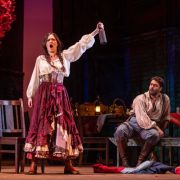
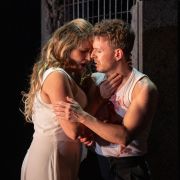
The cast was uniformly excellent, with respect to singing but also, emphatically, acting. Hattie Marshall brought to bear her powerful soprano with a convincing dramatic depiction of Blanche DuBois’s affectations, longings, vulnerability and her final descent into mental disorder, with affecting lyrical renditions of the best known aria-like “I want magic” and the monologue, “I can smell the sea air”. The role of Stanley Kowalski is perhaps even more challenging, having to grapple with memories of Brando, as well as depict a brutish committer of domestic violence and worse while convincing us that Stella continues to love him (without getting into contemporary debates about coercive control). Lachlan Higgins, while somewhat slight of frame, nevertheless managed to swagger around aggressively, an impressive performance, although his villainy was rather offset by his suave baritone singing.


Prudence Sanders was an ideal Stella, torn between love for husband on the one hand and sister on the other. Her lovely lyric soprano was if anything underused here, but got something of an airing in the wordless vocalise at the end of Act 1. As Mitch, tenor Kohsei Gilkes also made the most of his role, worrying about his sick mother and responding to Blanche’s overtures with romantic lyricism until disillusioned by Stanley. In the smaller roles, Caitlin Cassidy (Eunice), Noah Humich (Steve), Vin Trikeriotis (Pablo) and, amusingly, Euan Macmillan as the Collector wondering what he was getting into, all played their parts and sang well.
Particularly in the second half, this is a compelling and gripping evening of theatre. Ultimately, however, one felt it was the power of Williams’ original writing which carries the dramatic day, rather than Previn’s music which certainly enhances but does not necessarily reveal more than is already there.