Money, greed and obsession are at the heart of Prokofiev's The Gambler. Adapted from Dostoevsky's novella, this frenetic work plunges us into a world where social pretensions mask financial desperation and the roulette wheel offers the tantalising possibility of escape. Tonight's performance in Wexford captured the thrill of risk and the ever-present prospect of ruin, with acerbic humour and spiky orchestral writing.

Set in the gambling resort of Roulettenburg, the opera follows Alexei, a young tutor consumed by his passion for Polina and his growing obsession with roulette. As the General awaits an inheritance, the arrival of his wealthy aunt, Babulenka, upends everyone's expectations. Her own gambling exploits and Alexei's eventual winning streak expose the destructive illusion that money can bring happiness.
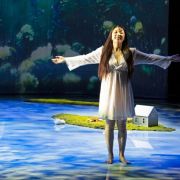
Director Ivan Popovsky’s vision for Prokofiev’s opera has a surrealistic element to it. Cast in monochrome colours of white and black, all the characters exist in a world governed by chance. Rather than try to depict a Victorian spa town, the world they inhabit becomes itself a game of roulette game, with objects and people spinning faster and faster out of control.


Maria Tregubova’s for the first two acts, however, are disappointingly simplistic. Two flimsy-looking white structures, marked ‘Hotel’ and ‘Casino’ in childish lettering, do little to establish a convincing dramatic world. Acts 3 and 4 fare better with the structures spinning around for Alexi’s bedroom, while the roulette table is visually engaging with a red triangular carpet. Tregubova’s costumes takes Victorian notions – top hats for the men, large hats for the ladies – and turn them nearly all white. Only the grandmother and her entourage are dressed in black. The visual symbolism reinforces the characters' entrapment within a world of chance.

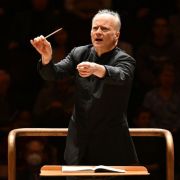
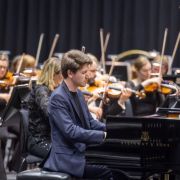
One remarkable aspect of tonight’s performance was the precision and drive of the Wexford Festival Opera Orchestra under Valentin Uryupin. The orchestra played a central role here in allowing the drama to unfold through rhythmic energy, instrumental colour and sudden shifts of mood. The score presents a formidable challenge of coordination, with its irregular rhythms and relentless forward momentum. The General’s motif lumbered along in the brass, while slithering strings and an insidious oboe often accompanied the Marquis.
The standout star of the evening was Igor Onishchenko as Alexei. His mellifluous, agile tenor conveyed both his character's initial romantic longing and his eventual descent into gambling obsession. Particularly effective was the way Alexei's lyrical lines became increasingly distorted and grotesque, mirroring his unhealthy fixation on Polina. There was real chemistry between him and Sophie Gordeladze, despite her complex relationship with him. She is not simply a passive romantic heroine: she has her own financial anxieties, vulnerabilities and fierce sense of independence. The relentless moto perpetuo leaves little room for vocal repose, making Act 4, in Alexei's bedroom, a welcome opportunity to appreciate her voice in a more relaxed setting. In the final scene she showed both power and great finesse though her true feelings for Alexei remained unclear.


Prokofiev's declamatory vocal writing, closer to heightened speech than conventional operatic lyricism, makes it difficult to appreciate the singers' voices in isolation. The general Alexei Botnarciuc possessed a booming bass voice showing himself to be ridiculous, pompous and almost farcical, but there was something rather sad about his desperation to preserve his status. Clarry Bartha's Babulenka was vocally less secure, with some hoarseness and limited projection, although she relished the role of the matriarch who upends everyone's financial expectations. Babulenka is more than comic relief; she exposes the same destructive impulse that eventually consumes Alexei.
The scene in the casino was of the most successful and enjoyable moments in the whole opera. It depicted the mad rush to lose one’s identity in the pursuit of easy money through a polyphony of cacophonous voices which swallowed up the desperate Alexei without resistance. Here the Wexford School of Ballet added much needed colour and vibrancy to the proceedings while there were some amusing touches like giant roulette balls.

Of the three main-stage operas at Wexford Festival Opera, The Gambler may offer neither the immediate melodic gratification of Rossini’s L’equivoco stravagante nor the sweeping emotional release of Mascagni’s Iris. Instead, Prokofiev delivers something more unsettling: a fiercely modern portrait of people who mistake the possibility of winning for the possibility of happiness. Despite some shortcomings in the staging, the musical drive of the performance and the mounting intensity of the casino scenes made for a compelling evening.
Andrew's trip was partially funded by Wexford Festival Opera.