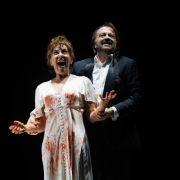
Rarely has the dislocation between what the eyes see and the ears hear been so pronounced. This performance of Purcell’s Dido and Aeneas (barely a semi-staging, let alone a full production despite a director’s credit for Andrew Staples) took place in the hall beneath the magnificent Cutty Sark, the venerable clipper’s keel an inverted gothic arch that loomed lengthways like a guillotine that threatened to slice the space in two.

Just as a ship is longer than it is wide, so is this hall. As a venue it blended gimmickry, maritime relevance and an aural bloom that glorified the Monteverdi Choir and English Baroque Soloists. A clever choice, then, but alas not a shrewd one. From my privileged seat in the critics’ block I had a better view than most, yet even that was limited. All audience rows in this 'found space' were flat, unraked, and (mostly) located far behind mine, so whole flanks of spectators will have witnessed nothing but a ship’s bulkhead and the backs of human heads. Perhaps that explains the need for so much processing up and down the central aisle or catwalk, we might call it, given the slinky, sultry fashions worn by Karima El Demerdasch as Dido and Johanna Wallroth as Belinda.


So much for the eyes. The ears, happily, were assailed by such bounties that the visual paucity was almost immaterial. From the outset, when the drum of Zands Duggan heralded not the main work but the first of several interpolated moments from Purcell’s Music for the Funeral for Queen Mary (making this a ‘greatest hits’ evening as well as a night at the opera), the harmonious melding of voices and instruments was blissful. As a reminder of how technical excellence can lift the soul and music commune with the numinous, this cushioned, rapturous performance left criticism redundant.

Doubtless the Monteverdis’ management will know why they cast their net overseas to snag their principals for this English performance of an English opera, but it cannot be denied that the German-Egyptian El Demerdasch and the Swedish Wallroth gave sublime accounts of Dido and Belinda respectively. While too many musicians may be without honour in their own country, both these artists were at one with the idiom and sang with impeccable precision and pronunciation. Wallroth in particular filled the space with a crystalline soprano beauty. Polish baritone Hubert Zapiór was a full-throated Aeneas, his rich timbre the equal of his colleagues. Only the fourth principal role was sung by a Brit – and equally well. How intriguing was the contrast between Bethany Horak-Hallett’s black-hearted Sorceress and her Pre-Raphaelite mien as an Ophelia clad in virgin white!


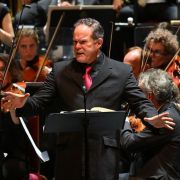
Conductor Jonathan Sells is a well-chosen replacement for John Eliot Gardiner, a compleat musician with all the verve but a less relentless drive than his predecessor. His conducting had a relaxed assurance that made Dido and Aeneas ring out with pure delight, the tapestry of his interpretation reaching a rarefied plane unexpected even in this august ensemble. Such was the evening's allure that the stylistic affinity who sprang to mind was less Gardiner than Paul McCreesh.
This review was updated on 26th May to amend an inaccurate claim that John Eliot Gardiner was not mentioned anywhere in the programme.