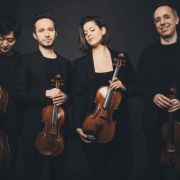
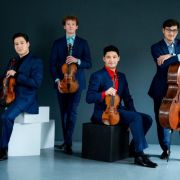
In the lead-up to next year’s 200th anniversary of Beethoven’s death, many string quartets around the world are embarking on the complete cycles: sixteen quartets that span the composer’s entire mature compositional career. The French Quatuor Ébène, who have performed and recorded the cycle previously (albeit with a slightly different line-up), are presenting cycles in Berlin, Rome, London and here in Tokyo at Suntory Hall (in its intimate Blue Rose Hall) as part of its annual Chamber Music Garden festival. What makes the Tokyo cycle special is that it is a six-concert concentrated cycle held over just eight days, whereas the other cycles are held in instalments. I was only able to catch them for one concert mid-cycle, but there were many chamber music enthusiasts who had tickets for the whole series.


The third concert consisted of three quartets from different periods, although none from his final years. They began the evening with the third quartet from the Op.18 set (published in 1801), which was actually the first one Beethoven composed. Quatuor Ébène has many unique features, among which is the lightness and transparency of sonority, and this was particularly clear in their performance of this quartet. The work opened in a gentle and breezy manner, but always with clearly articulated phrasing. In the lyrical second movement, they took us through Beethoven’s captivating modulations with a warm and mellow sound. In contrast, the virtuosic finale was taken at a thrilling pace, with the players almost spurring each other on.
This was followed by the Op.94 “Serioso”, a dramatic and intense work composed in 1810, his last before his late quartets. The first movement was taut and punchy throughout – the development was particularly aggressive – which contrasted with the solemn second movement, where the fugal sections were carefully crafted. In the de facto Scherzo, they manoeuvered the relentless galloping rhythms with verve and, in the finale, they moved seamlessly and effortlessly from the slow introduction to Allegro agitato, and then to the effervescent coda.

What captivated me most in this piece and in the second Razumovsky quartet after the interval, was the way the Ébène’s playing often transcends bar lines and metres, and gives the music flexibility and flow – a kind of ‘groove’ even – that is utterly their own. Their treatment of the syncopated rhythms in the first movement of Razumovsky was a case in point. The players captured phrases in long spans with spontaneity and suppleness, which was evident not only in the sublime slow movement, but also in the rhythmically intricate third movement that features the Russian theme. For the four players to perform in sync in such a natural and organic way is really awe-inspiring; one could say they are taking Beethoven’s quartets to a new level. I could quibble and say that, historically speaking, the Schupannzigh Quartet would never have played in such a way in Beethoven’s time, but who can really complain about such stylish and high-level playing?


Coincidentally, on the day of this concert, the Ébènes announced that all four players will now perform on Stradivarius instruments: Piatti (1717), King George (1710), Gibson (1734), and De Kermadec-Bläss (1698). To be honest, I couldn’t tell if their sound was different from when I heard them last summer in Yokohama, but their interpretations will surely further deepen as they continue their Beethoven journey with these prestigious instruments. Do catch their cycle if you can.