From time to time, you see a show that verges on perfection. An impressive new production of Tancredi at the Teatro dell’Opera di Roma is such a show. It brings Rossini’s opera, to a libretto by Gaetano Rossi, back to the Roman stage after 22 years. Emma Dante’s production chooses the Ferrara finale, which is the tragic one, based on Voltaire’s homonymous tragedy, which was only rediscovered in 1976. The original finale, and the one that remained in the repertoire after the premiere in 1813, had a happy ending, as the audience at that time preferred.

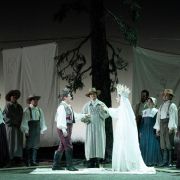
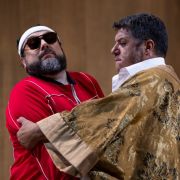
Dante’s idea is both simple and brilliant: she stages the story as an ‘Opera dei Pupi’ show, a traditional Sicilian puppet theatre based on medieval epic literature. We therefore see the characters dressed like puppets hanging from ropes, over richly coloured painted backgrounds. Her concept comes almost naturally, as the story of Tancredi is based in Sicily and is loosely based on a Sicilian historical figure.


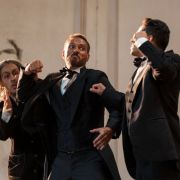
But there’s another, more subtle and interesting layer to her choice. Initially we see the singers, all dressed in black, acting as the puppeteers, manoeuvring the puppets (non-singing actors). Later, these puppeteer-singers put on the lively puppet costumes themselves (by Dante and Chicca Ruocco) and the puppets come alive. Dante couldn’t have found a more fitting metaphor for characters that come alive from the literary – or musical – page during the course of a show and that’s exactly what happens in this case. Tancredi belongs to the large bel canto category of operas where nonsensical plots are set to beautiful music. What could have well been a deathly story of stereotypical characters in an unbelievable plot, slowly takes real shape, thanks to both Rossini's music and the singers’ interpretations. Likewise, little by little, Carmine Maringola’s set becomes more abstract, and from a literal description we move towards more symbolic territory, “from the realism of facts to realism of feelings” (Dante).

Opera di Roma’s Music Director Michele Mariotti is completely at home in Rossini, being a native of Pesaro (the composer’s hometown) and having had long familiarity with the Rossini Opera Festival, his father being the festival founder. Conducting an orchestra on particularly good form, he gave a vivid reading of the multiple folds and facets of Rossini’s score, starting from the sinfonia’s crescendo, which the audience was able – for once – to listen to undisturbed, with the stage curtain still down. The rendition of the prelude to the Act 2 prison scene was poignant, with the clarinet solo well contrasted against the waves of sweeping cellos and double basses. The alternative finale made for a display of the very controlled use of the violins which accompany, scattered in delicate pianissimos, Tancredi’s final words. At the opposite end of the spectrum, the concertato at the end of Act 1 was in full Rossinian mode.


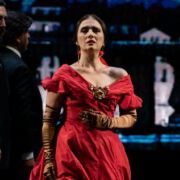
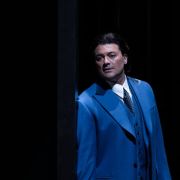
Mariotti made the unique choice of casting a countertenor instead of the usual contralto or mezzo in the title role. Carlo Vistoli’s performance was an absolute triumph, for both the beauty of his voice, rich and natural in tone, and for his perfect singing in every register. Soprano Martina Russomanno was as impressive as Amenaide, so much so that it was almost difficult to match her youthful age with the maturity of her performance. Not only did she have perfect command of her medium and brilliant coloratura (as in the cabaletta “Ah! d'amore in tal momento”), but she made the character her own.

Luca Tittoto lent his beautifully deep bass voice to the evil Orbazzano. It was easy to forgive tenor Antonino Siragusa’s few technical slips given the lovely, luminous timbre of his voice as Argirio. Young mezzo Ekaterine Buachidze showed an assured technique as Isaura, with her extended tessitura and confident stage presence. With her distinctive, velvet timbre, mezzo-soprano Maria Elena Pepi (still part of the Young Artist Program ‘Fabbrica’) never fails to stand out in the smallest of roles, leaving you with the strong curiosity to see her in bigger parts. Finally the all-male chorus, directed as usual by Ciro Visco, played no little part in the success of the evening.

All in all, this Tancredi is a masterclass in how to stage a ‘far away’ opera in a modern way, with the focus remaining firmly on the quality of the musical performances.