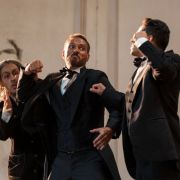
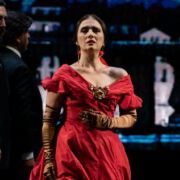
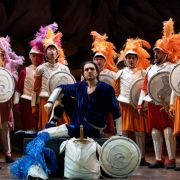
In a way, the opening of Puccini’s La bohème at the Teatro dell’Opera di Roma felt more like the opening of the season, so beloved this opera is (with all due respect to Wagner, whose Lohengrin opened the actual season last November). This is a co-production with Palau de Les Arts Reina Sofía of Valencia, and was first staged at the Caracalla Baths in 2014. One can actually imagine the set choices being ideal for the outdoor venue, but they adapted well to the theatre.

Director Davide Livermore designed the set, costumes and lighting. These days, it feels like a strange relief to go to the opera and watch a traditional staging of a classic. Although this isn’t a realistic setting, it is a substantially traditional rendering of the story, with colourful period costumes and the locations of each of the four acts are between the descriptive and the symbolic. Next to the realistic elements, one or all of the walls (through huge LED screens by D-Wok) reproduce in a large scale more or less well known Impressionist or Post-Impressionist paintings, the most famous of which is Van Gogh’s Starry Night, with an overlay of the Eiffel Tower’s silhouette, both dating from 1889. The apparent anachronism with the original story set in the 1830s is justified by setting the same in 1896, the year the opera premiered. What can seem like a trivial choice (famous coeval French paintings) carries a deeper, less obvious layer: Puccini’s swift musical brushstrokes in Boheme have the same originality and impressionistic quality of those paintings. In this regard, Livermore’s pairing is ingenious. The addition of (digital) snowflakes makes the visual impact rather impressive.


The singing was almost as impressive as the staging, with the Orchestra del Teatro dell’Opera di Roma conducted by Jader Bignamini. Tenor Saimir Pirgu was at ease in the role of Rodolfo, reaching each and every one of his high notes effortlessly, even if his technical prowess made the scarcity of nuance in his phrasing go mostly unnoticed. As Mimì, soprano Carolina López Moreno was making her debut at the Costanzi. Perhaps because of the emotion, her first aria “Mi chiamano Mimì” stumbled in a couple of places, with the high notes of “che parlano d’amore” and “Così gentile il profumo d’un fiore” thinning audibly. She also looked a bit rigid in the first scene, but the rest of her performance was very strong, her voice displaying a soft, warm tone.

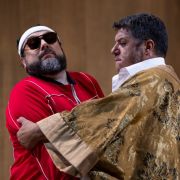
Baritone Nicola Alaimo was a jaunty Marcello, his singing more satisfying than his recitatives, while mezzo-soprano Desirée Rancatore found the humour in the role of Musetta. The supporting characters of Schaunard and Colline were well taken by Alessio Arduini and William Thomas, the latter displaying a memorable, dark voice. Matteo Peirone was a histrionic Benoît and Alcindoro.
A special mention must go to the Chorus of the Teatro dell’Opera (prepared as usual by Ciro Visco) and to the children of the Scuola di Canto Corale (prepared by Alberto De Sanctis) who delivered, with the rest of the cast and with a number of special effects, what was perhaps the most memorable scene in the show, that of the Cafè Momus, with the arrival of toy seller Parpignol (Giordano Massaro). The streets of Paris really came alive! Four young ballerinas from the Scuola di Danza del Teatro, Degas-style, were a spurious but cute addition.


La bohème is quintessential opera. Mimì’s death is not just a tragic fatality; she is the very symbol of youth and its inevitable end. Livermore’s show hits the target. Being touched by the depiction of humanity through the magnifying lens of aesthetic beauty – isn’t this what opera is all about?