One thing you can say for sure about Sir David McVicar: He is not boring. The celebrated Scottish opera director’s take on Richard Strauss’s Salome debuted this past weekend at Lyric Opera of Chicago, with Julia Burbach reviving the 2008 Royal Opera House production.

The show displayed strengths and weaknesses typical of McVicar’s oeuvre. Taking the good with the bad makes for a memorable day at the opera, even if there is some head-scratching to follow.
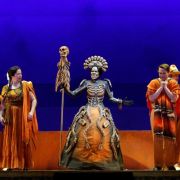
First, the strengths. Striking visuals are the hallmark of a McVicar production, and Salome delivers. The main set is divided horizontally such that the upstairs, where Herod’s feast is taking place, takes up the top fifth of the stage. You can see the banquet table and seated guests – mostly with their backs to us – and an adjoining room where a spiral staircase leads downstairs, to a mildewy, vaguely green basement. The contrast is terrific, and the proportion carries a message about how there’s more of the seedy underbelly than the glittery surface in this opera.


The Dance of the Seven Veils in this production does not show Salome seducing Herod with undulance and striptease. Instead, Salome and Herod pass through a series of rooms illustrating the development of an abusive relationship between stepfather and stepdaughter. It’s a theatrical coup, with the walls passing from left to right and allusive, wordless storytelling, bold images following one after another.
This daring choice, adding some non-canonical backstory and depriving the voyeurs of their titillation, hit its mark on humanizing Salome, explaining that her bloodthirsty volatility is the obverse of her psychological damage. And the seeds of this really are in the libretto: Herodias’s harping on Herod not to stare at Salome, and the idea of a reward for sexual behavior. It also evokes Bluebeard in its tour of seven rooms, doing some of the work of painting Herod as a serial abuser by association.

Beyond the production, this Salome was killer. Jennifer Holloway, who specializes in Salome, oscillated among affects persuasively, making her manipulations and her simultaneous, contradictory emotions feel not just plausible but inevitable. She navigated the range demands of the role ably, and her final, most insistent “Gib mir den Kopf des Jochanaan” was chilling.
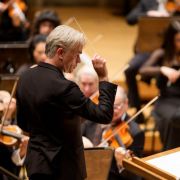
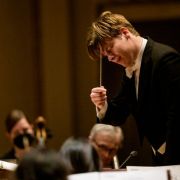
Tomáš Netopil led the Lyric Opera Orchestra with firm control of volume, in an orchestration that could easily overwhelm the singers in this 3,000-plus-seat house. He swelled the sound dramatically even in brief interstices between sung lines to keep the orchestra sounding like it could erupt at any moment. Woodwind solos, too, really sang.
Nicholas Brownlee as Jochanaan also shone vocally and accomplished an acting feat of responding to Salome’s impertinent attentions with a dignified detachment. Alex Boyer succeeded in garnering some sympathy as Herod, even if he came off a bit snarling, going to the trough of decaying a sung line into speech one too many times. Tanja Ariane Baumgartner, singing Herodias, brought a gorgeous dark tone and hauteur to her portrayal.


Now for weaknesses. The psychic backstory version of the Dance of the Seven Veils, like many rethought opera concepts, obscures the nuts and bolts of the story. Salome first-timers might leave not understanding what has happened on the most literal level, to gauge from some post-performance muttering. It’s possible both to present the fanciful psychological passage and to keep the audience clued in, but this version doesn’t spell it out.
McVicar also does not get any mileage out of changing the setting to fascist Italy. The design not only does not really read specifically as Italy, except perhaps to connoisseurs of antique military uniforms, but it also does not really engage with fascism –a missed opportunity in our current reality.
The ideal audience for McVicar’s Salome is opera buffs who have seen other Salomes. People who have seen other McVicars, too, however, are less than ideal, because he does repeat himself. Even a semiregular Chicago-only operagoer might have noticed distracting connections: a historical setting between the world wars (Wozzeck), hanging butchered meat (Rusalka), women in slips (Macbeth, Rusalka), people sprawled on staircases (Elektra), and characters spending most of their time on the floor (Medea).

The stylistic tics and the unclear storytelling are a small price to pay. This Salome is well worth seeing, hearing, and – as McVicar surely hopes – thinking about.