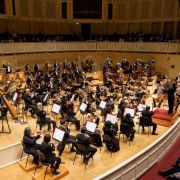
In the long runway to Klaus Mäkelä’s tenure as the Chicago Symphony Orchestra’s Music Director, beginning with the 2027-28 season, his guest appearances bring heroic-size crowds to the hall. In the subscription program that premiered this past Thursday, he programmed heroic music to match.

The dipartite program paired two works with a great number of similarities: Jean Sibelius’ Lemminkäinen Suite and Richard Strauss’ Ein Heldenleben. Both pieces were composed in the 1890s, employ a large orchestras, last 40-some minutes and illustrate the lives of heroes. In the Sibelius, the hero is Lemminkäinen, the protagonist of the Finnish national epic the Kalevala. For Strauss, it is himself.


There’s some danger that such a program would come off too matchy-matchy, with no overture or concerto to provide contrast. Mäkelä’s intensely dramatic interpretations, however, meant that each piece supplied enough internal contrast to make each 45-minute half fly by.
After a patient pause for total silence – a gambit Chicago has often seen from Riccardo Muti – Mäkelä launched the first movement of the Sibelius, Lemminkäinen and the Maidens of Saari, the horns delivering the unsettled, high-register opening chord with crystalline tone, a harbinger of the virtuosic orchestral playing to follow.

For The Swan of Tuonela, Mäkelä coaxed a tremolo as quiet as breathing from the Chicago strings to prepare the mood for a gorgeous solo from Scott Hostetler on the English horn, standing for this movement at a music stand placed beside his regular seat. A theme of Mäkelä’s presentation of both the Sibelius and the Strauss was the careful preparation of space in the sound for melodies. Sibelius often first lays down the texture of the background, as if building a nest, before admitting a tune to roost. Mäkelä followed Sibelius’ logic and built an environment that let Hostetler’s solo soar.
The only passage that felt less than stellar was in the fourth movement, Lemminkäinen’s Return, when twiddling gestures in the winds must coordinate with fast figures from the strings. Here the effort of holding the ensemble together became noticeable, with some tension in the atmosphere. But then the brass came blasting in, and everything was jake.


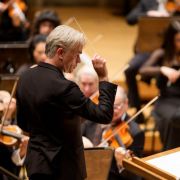
In the Strauss, as in the Sibelius, Mäkelä found a whole spectrum of colors and moods. He brought podium gestures to match, with mime-like expression, here a flippant wrist-flick for some dashed-off pizzicatos – making a few audience members chuckle in surprise – and there a flopping marionette pose to invoke insouciance. He managed noise and chaos with aplomb equal to the passionate section solos. The final chord of the piece spoke with such unflinching clarity that if you closed your eyes you could swear you were hearing a pipe organ. A nit to pick with the Strauss: the solos from concertmaster Robert Chen lacked the conversational phrasing and expressive vibrato Mäkelä drew out of whole string sections elsewhere in the piece. Chen also undershot a third near the end of the piece distractingly.
A delight of listening to this orchestra as led by Mäkelä is his mastery of the audience’s attention. Like a good stage director leading the eye to the locus of the action, Mäkelä knows where the conscious ear will travel and rewards it with expressions, contrasts, and articulations that show reasoning behind them, as if delivering an essay or a sermon. Mäkelä is speaking. Chicago is listening.