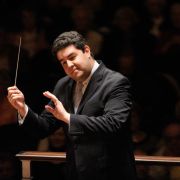
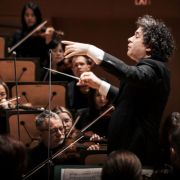
Esa-Pekka Salonen was back in Disney Hall on Friday night, opening a two-week engagement in a program that revolved around humanity and nature, with his fellow Finn’s penultimate tone poem, The Oceanides, at the head.

Salonen, never reverent in the interpretation of Sibelius’ work, found an ideal vehicle in The Oceanides, a work Sir Thomas Beecham once called “very strange”. And so it sounded here; less a late example of Romantic musical imagery than anticipation of the clashes of color and harmony that characterized music after the Great War. Salonen built the great climax that precedes the coda with subtlety, ratcheting up the tension from the very opening measures, where the Philharmonic strings, playing with the elegance that has been an enduring legacy of their former boss, materialized seemingly imperceptibly.


It was followed by a new work that could also be described as a “tone poem”. Actually, Gabriella Smith’s Rewilding is another example of the 21st-century revival of program music, only now referencing social or political topics, instead of the more strictly pictorial inspirations from centuries ago. Drawn from her interest in ecological issues, her score utilizes, among other things, “found” objects usually consigned to landfill piles. More interesting as an idea, perhaps, than in execution; her panoply of metal bowls, bicycle spokes, and so on sounded so similar to one another, and even to traditional percussion instruments. In one passage, the orchestra gave way to a miniature cadenza of these objects, which only furthered their impression of timbral monotony, that was not helped by this score’s reliance on threadbare post-minimalist tropes, patched over with bits of DIY Messiaen and Lutosławski. “Rewilding” this music may have intended to depict, but it was even more illustrative of this century’s regressiveness.
One can often distinguish the great musician from the merely good just by their ability to elevate lesser music. La Damoiselle élue, which followed after the interval, is minor Debussy, no doubt, but Salonen made its Wagnerian reveries sound nearly great. Although sung superbly by soloist Liv Redpath, Jingjing Xu and the Los Angeles Master Chorale, it could be said that the orchestra nearly usurped them. Salonen blended them with mastery, of course, but the sheer beauty of the orchestra was hard not to appreciate in and of itself.


They certainly had the audience’s focus entirely to themselves in the final work, Scriabin’s Prometheus. They were joined by guest soloist Jean-Yves Thibaudet, whose pianistic gyrations amped the sybarite power of this music.
Multimedia artist Grimanese Amorós contributed the actualization of Scriabin’s synesthetic vision for the music in this performance. One wondered, at first, how she would bring it off: the centerpiece was a scrim hung behind the orchestra that looked like a set piece from The Price is Right. Concerns were dispelled as soon as the “mystic chord” sounded. Light played and twirled with sound, never overpowering it, and finally fusing together with it at its roof-raising coda, where Scriabin and Amorós both snapped their audience from its trance with a wash of all-consuming light.