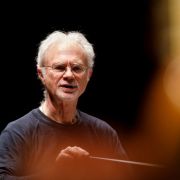
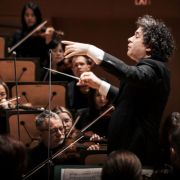
John Adams left skeptics of his conducting career in the dust a long time ago. His mastery as creator and interpreter, as the audience at Disney Hall heard last Friday night, are fully equal to each other, in the tradition of Mahler and Richard Strauss.

To be sure, Adams is a refreshingly idiosyncratic and very composerly conductor. Finesse isn’t a priority for him; the Los Angeles Philharmonic can handle that on its own just fine. Adams, instead, uses his insider’s view to take a composition apart and emphasize its scaffolding rather than hide it, even if that comes at the cost of smoothness.
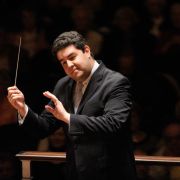
His performance of Ives’ The Unanswered Question made a telling contrast with Dudamel’s. Whereas the latter draws out the piece, coaxing playing from his strings that hovers just above audibility, Adams was fleeter, starker, more willing to intervene interpretively. He also wasn’t afraid of disrupting textures – the off-stage flute chorale sounded a striking contrast in this performance.


Roy Harris’ Third Symphony was an especially welcome inclusion in the program. Once the flagship of the American symphony, this tough and compact work is now a 21st-century semi-obscurity. (It hadn't been heard in the Greater Los Angeles Area since 1998.) A solid run-through alone would’ve been appreciated, but Adams did his audience better than that; his interpretive artistry was especially winning here. Instrumental attacks had an appealing boldness bordering on the coarse that work well in Harris’ earthy music. The conductor’s penchant for disruptiveness also paid off in greater linear clarity, important in this rigorously constructed fusion of drama and symphonic logic. Evidently an admirer of the symphony, Adams took care with the presentation of this highly original music; the Harris Third was as much celebrated as it was played.
Copland’s Appalachian Spring, on the other hand, has never lost its perch atop the American musical pantheon. A slightly more relaxed approach guided Adams here, although it was an alert performance all the same, with emphatic percussion punctuating Copland’s syncopated rhythms. The conductor also took care to bring attention to the score’s proto-minimalist passages.

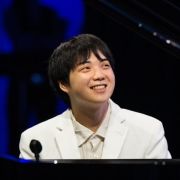
Before the program’s turn to Appalachia came After the Fall, one of Adams’ recent works, heard here in its local premiere. A pedal point emerges from the darkness, over which an array of gamelan gongs flutter. Layered textures, washing over in waves, sometimes complimentary, other times threading into one another follow. Enter the piano, played with suavity by soloist Víkingur Ólafsson. He displayed virtuosity of focus above all else – After the Fall isn’t so much a concerto as a partnership between orchestra and piano concertante. Often the soloist comments self-effacingly on the doings of the orchestra; when it does take the lead it is in the spirit of “first among equals”.


The usual Adams trademark glittering textures and lush orchestration were heard here, albeit with a new lightness, of textures pared down and broken up that suggest we’re in the midst of an Adams late period. These were brightened with touches of postwar exotica that evoked the likes of Les Baxter, perhaps by way of Michael Daugherty’s Le Tombeau de Liberace. Adams ventured further back for the finale’s inspiration – it’s based on a prelude from Bach’s The Well-Tempered Clavier. He developed this into a motoric pastiche that decisively concluded one of the most effective recent works by this composer-conductor.