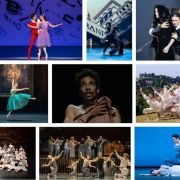
There was a collective sigh of relief and jubilation at The Royal Ballet opening night of So Are We: León and Lightfoot. After 37 years of choreographic collaboration, more than 60 creations and worldwide acclaim, Sol León and Paul Lightfoot have finally presented a double bill of works on the main stage of the Royal Opera House. It was somewhat overdue but oh… so well worth the wait.

Shoot the Moon was created 20 years ago for Nederlands Dans Theater where they have both had a long association, first as dancers, then choreographers and in Lightfoot’s case, as artistic director. That the work has transferred so well to a company made up of very different dancers is a tribute to the company, stagers and of course León and Lightfoot.
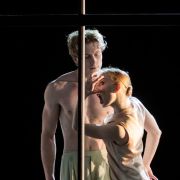
In a cast of five principals, a couple of camera operators, a trio of scene shifters, this was a seamless window into complex, sometimes angst-ridden relationships. The set design (also León/Lightfoot) is a simple but effective view of three rooms and one window which revolves in order to observe the interactions of the protagonists.


Music by Philip Glass, the second movement of his Tirol Concerto, beautifully played by Robert Clark in the pit, conveys precisely the constant ebb and flow of the unfolding dynamics between them. Visually, it’s cinematic, as the large screens above the rooms, occasionally zoom in on the facial expressions. The dance vocabulary is wonderfully inventive and idiosyncratic, full of surprises and layers. At this performance the roles were taken by Anna Rose O’Sullivan, Vadim Muntagirov, Matthew Ball, Lauren Cuthbertson and Lukas B Brændsrød.
There was a remarkable moment when Ball was spying through the keyhole at Cuthbertson and Brændsrød, his eye blinking and larger than life on the screen, in quiet disbelief. The use of the walls as body props also worked for me, a sort of indication that there are always physical boundaries that restrict emotional freedom. Supremely invested performances from each of the cast made for very compelling viewing.

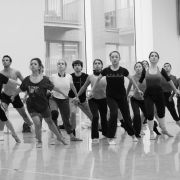
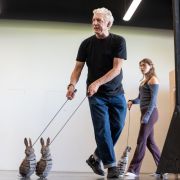
And if this wasn’t already impressive enough, the world premiere of Salle de danse was an entertaining spectacle that invited repeated viewing. The original idea began as a film project during the pandemic with Lightfoot using the daily ballet class as a starting point. This concept has most famously been used in Harald Lander’s 1948 Études, to piano studies by Carl Czerny. Starting with barre work and building up to a crescendo of grand allegro, Salle de danse is León/Lightfoot’s 21st-century response and antithesis to Lander’s squeaky clean classicism – but every bit as enjoyable.
With a brand new score by Ilya Demutsky, including very strong references to Czerny, especially towards the end in the Tarentelle and Mazurka, the hour-long piece sees the dancers, a cast of 45, put through their paces in all the traditional exercises – port de bras; pirouettes; relevés; rond de jambe – but in a fresh, revelatory guise.


It opened with Francesca Hayward and Marcelino Sambé giving us a Prélude to what we might expect and yet for the entire duration, the levels of innovation kept surpassing the previous episode. The large cast included all ranks of the company and each of them is worthy of a mention.
Some highlights were Joseph Sissens’ Rond de jambe. He licked the floor with his metatarsals and supple, liquid moves and brought new emphasis to this standard exercise. Melissa Hamilton and Martin Diaz stretched beyond the norm in Étirements with a tongue in cheek ending. Explosive results came from the Ensemble number, the stage filled with military-esque execution and an abundance of truly excellent, disciplined dancers.

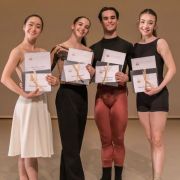
Alejandro Muñoz and Harrison Lee showed us what it looks like to turn like a top in Pirouettes. Especially pleasing to see these two shine as they showed such promise at their respective graduation performances. Caspar Lench and Ravi Cannonier-Watson were hugely touching in their Pas de deux romantique. The ending charmed as Lench curled up in Cannonier-Watson’s hold.
Marianna Tsembenhoi’s over-too-soon Solo prima ballerina left us wanting more, as did Luca Acri’s Coda. By the time we had reached Hayward’s de-robing from her extraordinary red gown, it felt as if the fireworks were very nearly out of control.

So much wit, precision and imagination packed into one hour is something I could get used to. More than anything, this dynamic choreographic duo appears to have breathed new life into The Royal Ballet. A triumph from every perspective – if you want excitement which makes you float all the way home, this is your ticket.